

ESTABLISHED IN 1967
Originally founded - Mt. Vernon Community College, 1955)
ACCREDITATION
Higher Learning Commission - The college has been accredited by HLC since 1969.
-
Higher Learning Commission
- 30 North Lasalle, St. Suite 2400, Chicago, IL 60602-2504
- Phone: (312) 263-0456
- Toll-free: 1-800-621-7440
- Fax: (312) 263-7462
- http://hlcommission.org
- info@hlcommission.org
APPROVAL
Illinois Community College Board
Illinois Board of Higher Education
Illinois Department of Professional Regulations
Published by the:
Board of Trustees, Community College District 521 / July 2026
Rend Lake College Student Handbook
Click on section below to navigate to that area of the page
Welcome to Rend Lake College
Rend Lake College Mission Statement
Statements & Notices
Welcome from President Dr. Lori Ragland
Campus Map
Academic Calendar
How to Reach Us
Weather-Related College Closings
Who to See? Enrollment Services / Student Success / Administrative Offices / Academic Divisions
General Information
Academic Standards
Academic Probation
Academic Suspension
Grading System
Graduation
Student Information
Campus Crime Rates
Access to Electronic Network
Summary of Civil & Criminal Penalties for Violation of Federal Copyright Laws
Access to Records
Directory Information
Criminal Background Checks
Americans with Disabilities Act
Policy: Discrimination & Harassment
Relationship to Local Judicial System
Social Security Numbers
Unattended Children on Campus Directory Information
STUDENT RIGHTS AND RESPONSIBILITIES / STUDENT CONDUCT CODE
Student Rights
Sexual Offender/Predator Registration
Student Complaints
Student Non-Academic Complaints
Student Responsibilities
Academic Integrity
Student Conduct Code
Disciplinary Procedures
Due Process Hearing for Students Recommended for Expulsion
Athletics, Co-Curricular & Extra-Curricular Activities
Degree Revocation
Student Optional Disclosure of Private Medical / Mental Health Information
Policy on Students with Disabilities
Smoking Policy
Alcohol and Drug Policy
Firearm Concealed Carry Policy
Communicable Disease Protocols
COLLEGE MISSION
MISSION:
The mission statement is the essential purpose of the college from which all college activities originate:
Rend Lake College provides accessible, high-quality educational opportunities which empower a diverse student population to achieve their goals and contribute to their communities. We are committed to our students’ success in achieving their academic and career goals and to meeting the workforce and training needs of our community.
With Rend Lake College, student journeys start here.
Value Statement: In serving our students and community, we are student-focused, authentic, and resourceful.
INSTITUTIONAL OUTCOMES:
Rend Lake College has adopted four essential learner outcomes, fundamental learning objectives embedded in every program of study, that all degree-completing students should be able to demonstrate. These are:
-
Critical Thinking: Demonstrate the ability to think in a self-directed, reflective manner when understanding, evaluating and solving problems.
-
Problem-Solving: Demonstrate the ability to resolve computational problems.
-
Oral Communication: Demonstrate the ability to communicate clearly, concisely, and effectively through verbal and non-verbal language.
-
Written Communication: Demonstrate the ability to communicate clearly, concisely, and effectively through written language.
WHO WE ARE:
Institutional history defines the College from the perspective of organization and assets; however, the people who operate within the college systems and manage those assets are the primary element for successful education. We believe all employees, regardless of their job description, are part of each student’s education. Administrative, community outreach, student service, and physical plant personnel all support the student learning process. Our instructors are primary points of contact with the Rend Lake College educational experience. These educators are generally organized into four divisions: Allied Health; Applied Science & Technology; Arts and Sciences; and Community & Corporate Education. Whether in a supporting role or as a direct point of contact, each college employee draws upon professional expertise and academic accomplishment to promote the success of every student.
WHO WE SERVE:
Student-centered colleges are best defined by who they serve. An understanding of the distinctiveness of our student population allows us to effectively meet the goals of our programs and succeed in our mission. RLC is committed to fair treatment, access, opportunity and advancement for all students, faculty, and staff, while striving to identify and eliminate barriers that have prevented the full participation of some groups.
Our population’s cultural distinctiveness is centered on age and socioeconomic status more than diverse ethnic origin. As global connectivity broadens, so too do our program offerings. We continue to serve groups with diverse characteristics, such as:
-
Age
-
Disability
-
Gender
-
National origin • Race/ethnicity • Religion
-
Socioeconomic status
-
Special populations
Rend Lake College provides general, transfer, and career technical education to both traditional and non-traditional students through the use of reciprocal agreements; regional, state, and national education programs; dual-credit high school classes; and opportunities for civic engagement. We offer skill and trade opportunities for students seeking employment and economic mobility. We also provide professional and personal fulfillment as well as growth through community and corporate education classes.
Often, an individual’s purpose for engaging with the college is a combination of factors such as:
-
Career Retraining
-
Discovery / Curiosity
-
Economic Mobility
-
Educational Requirements
-
Enrichment / Hobby
-
Healthy Lifestyle
-
Lifelong Learning
-
New / Enhanced Skills • Retraining
Rend Lake College values neurodiversity, including conditions such as autism, ADHD, dyslexia, and dyspraxia, as a crucial aspect of human variation that enhances our educational journey and community. Our commitment is to foster a supportive environment where neurodivergent individuals are acknowledged, respected, and enabled to unleash their full capabilities.
Working together, we can create a brighter future for all individuals, including those with neurodivergent conditions, by providing them with the necessary resources, support, and opportunities for success in and out of the classroom. Our commitment to embracing neurodiversity and learning more about its impact will bring positive outcomes for everyone involved.
COMMON OUTCOME:
Regardless of the cultural backgrounds, purposes or origins of our constituents, Rend Lake College serves each individual equally with an open admission policy and an opportunity for success. Furthermore, Rend Lake College is united by the shared commitment of students, faculty, staff, and community to meet its institutional, educational, and program objectives.
Rend Lake College values neurodiversity, including conditions such as autism, ADHD, dyslexia, and dyspraxia, as a crucial aspect of human variation that enhances our educational journey and community. Our commitment is to foster a supportive environment where neurodivergent individuals are acknowledged, respected, and enabled to unleash their full capabilities.
Working together, we can create a brighter future for all individuals, including those with neurodivergent conditions, by providing them with the necessary resources, support, and opportunities for success in and out of the classroom. Our commitment to embracing neurodiversity and learning more about its impact will bring positive outcomes for everyone involved.
NOTICE OF DISCLAIMER:
The content of this handbook is provided for information to the student. It is accurate at the time of printing, but is subject to change from time to time as deemed appropriate by the College President or Board of Trustees in order to fulfill the College’s role and mission, not to accommodate circumstances beyond their control. The provisions of this handbook do not constitute a contract, expressed or implied, between the College, an applicant, student, or student’s family. Students are responsible for the information contained in this handbook and are presumed to have knowledge of the rules set forth herein.
NOTICE OF NON-DISCRIMINATION:
Rend Lake College does not discriminate in any of its policies on the basis of race, color, national origin, sex, disability, or any other status protected by law. Questions about Title IX or Disability Access may be directed to titleix@rlc.edu or das@rlc.edu, respectively.
PRESIDENT’S WELCOME

Welcome to Rend Lake College. As we look ahead, we are optimistic about the opportunities on the horizon at The Lake. Our college has long served as a center for access, opportunity, and community progress, and our commitment to this responsibility continues to strengthen. We believe when we address the needs of each student we are supporting the growth of our region.
You can trust that your education at Rend Lake College is both current and effective. Our vision focuses on creating and strengthening crucial partnerships within our community and across the industries of Illinois. Learning extends beyond the classroom, and working closely with local businesses and organizations allows us to establish practical pathways for our students. These valuable partnerships make possible the hands-on experience, internships, and direct access that lead to meaningful careers.
Excellence in teaching and learning remains central to our mission. Our faculty and staff are valued professionals, and we are committed to investing in their ongoing development. By doing so, we ensure our students receive an engaging and impactful educational experience. This commitment to professional growth helps ensure every program, course, and service better aligns with our students’ goals.
We are also committed to responsibly managing our resources. This includes modernizing our facilities, and implementing forward-thinking strategies when it comes to our campuses in Ina, Mt. Vernon and Pinckneyville. By providing reliable and supportive environments that allow students to focus on their academic and personal development, we can maintain a strong foundation for the college’s continued success across the district.
At RLC we encourage students to be active, informed contributors to society. Service-learning projects, volunteer initiatives, and other civic engagement opportunities on campus offer avenues for students to make a meaningful impact on our communities and beyond.
As you plan your next steps, we invite you to consider how Rend Lake College can play an important role in your future. Our institution is dedicated to your development and success, and we are committed to being innovative and connected.
We look forward to welcoming you to campus and working together on your journey.
Sincerely,
Dr. Lori Ragland
President, Rend Lake College
Campus Map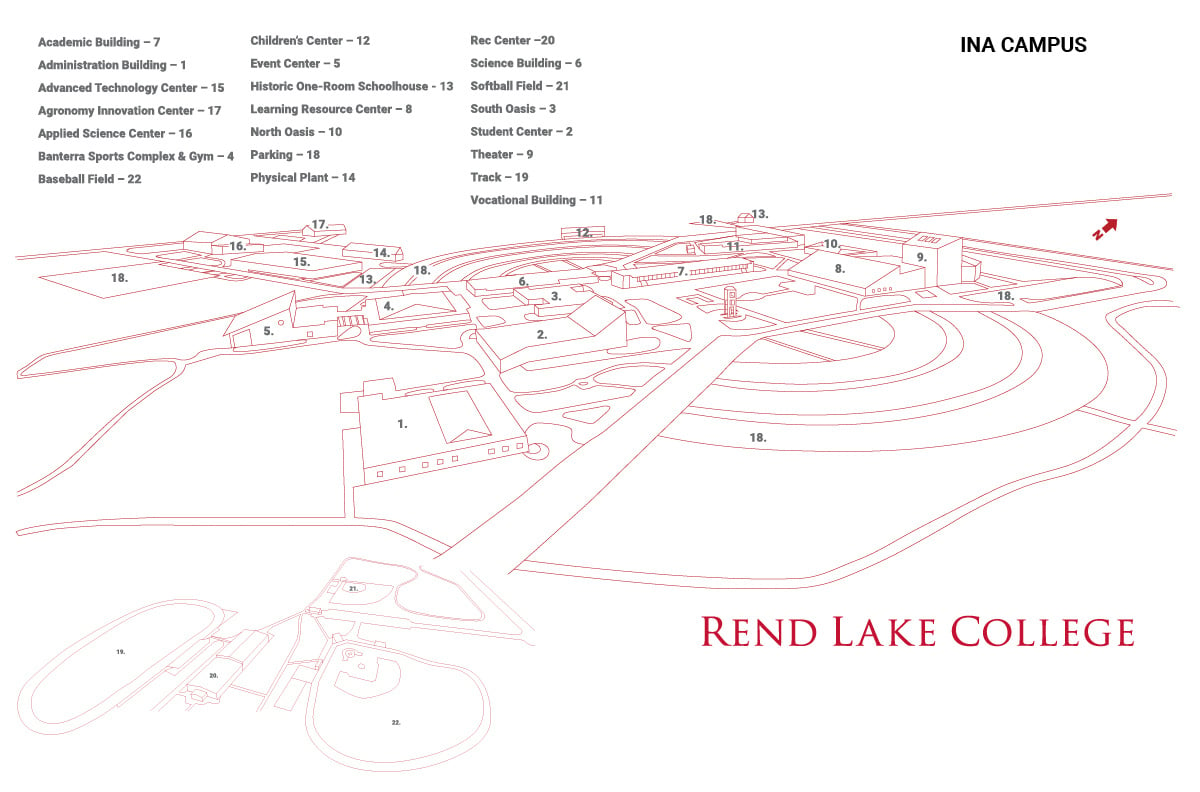
ACADEMIC CALENDAR 2026-2027
FALL SEMESTER 2026
Faculty Orientation ...........................................................................................................................Thursday, August 13
Student Learning Day (Faculty) ............................................................................................................ Friday, August 14
First Day of Classes ........................................................................................................................... Monday, August 17
Labor Day Holiday ......................................................................................................................... Monday, September 7
Fun Fest (no classes 12:00-3 PM -morning & night classes will meet) ............................. Wednesday, September 16
Midterm .................................................................................................................................................. Friday, October 9
Columbus Day Holiday ..................................................................................................................... Monday, October 12
In-Service (no classes day or night - on or off campus)................................................................. Tuesday, October 13
Veteran’s Day Holiday ................................................................................................................... Tuesday, November 11
Thanksgiving Holiday ............................................................................................ Thursday-Saturday, November 26-28
Last Day of Regular Classes .............................................................................................................. Friday, December 4
Semester Exams .......................................................................................................Saturday-Thursday, December 5-10
INTERSESSION
5 Week Intersession .................................................................................... Monday, December 14 - Friday, January 15
SPRING SEMESTER 2027
Student Learning Day (Faculty)............................................................................................................. Friday, January 8
First Day of Classes ......................................................................................................................... Monday, January 11
Martin Luther King’s Birthday .......................................................................................................... Monday, January 18
President’s Day ................................................................................................................................ Monday, February 15
In-Service (no classes day or night - on or off campus)................................................................ Tuesday, February 16
Midterm ..................................................................................................................................................... Friday, March 5
Spring Break (offices open Monday-Friday) ................................................................... Monday-Saturday, March 8 -13
Good Friday Holiday ................................................................................................................................ Friday, March 26
Last Day of Regular Classes ........................................................................................................................ Friday, May 7
Semester Exams ................................................................................................................ Saturday-Thursday, May 8-13
Commencement .................................................................................................................................... Saturday, May 15
SUMMER TERM 2027
First Day of Classes .................................................................................................................................Monday, June 7
Juneteenth ........................................................................................................................................... Thursday, June 17
Midterm ........................................................................................................................................................ Friday, July 2
Independence Day Holiday (observed).................................................................................................... Monday, July 5
Last Day of Classes ................................................................................................................................... Friday, July 30
WEATHER-RELATED COLLEGE CLOSINGS
In situations where inclement weather may affect the normal operation of Rend Lake College, or when circumstances beyond the college’s control may affect working conditions and create a need to call off classes or close the campus for whatever reason, this information will be announced in several ways. In these cases, the announcement will be made as soon as possible when a decision to close has been reached. Campus closures will be announced via these methods:
-
Wireless Emergency Notification System – This free service alerts subscribers to school closings via text message and / or email. Register for WENS at www.rlc.edu/wens.
-
RLC Home Page – www.rlc.edu
-
RLC Experience App - Download from Play or App store
-
Facebook – www.facebook.com/rendlakecollege
-
WarriorMail – Email to student WarriorMail accounts
-
Campus Switchboard – Automated message
In addition, the college will notify the main television stations in our district – WSIL, WPSD and KFVS. Additional media may also be notified.
Because of the size of the Rend Lake College district, it is possible that weather conditions will vary from location to location. In these cases, it is up to the student to choose whether or not to attend. When classes have not been cancelled and a student chooses not to attend, the attendance policies for the student’s classes remain in effect.
CONTACT INFORMATION
Call us - (618 437-5321
See us - 8-4:30 PM Mon-Thur, 8-4 PM Fri ; 8-4 PM Mon-Thur During Summer
Visit us - www.rlc.edu
Email us - advising@rlc.edu
Join us -
- Facebook: https://www.facebook.com/rendlakecollege/
- X: https://x.com/RendLakeCollege
- Instagram: https://www.instagram.com/rendlakecollege/
- LinkedIn: https://www.linkedin.com/school/rend-lake-college/
Fax to - (618) 437-5677
Mail to - 468 N. Ken Gray Pwky, Ina, IL 62846
WHO TO SEE
ENROLLMENT SERVICES
..................................................................................................Jena Jensik, Dean of Enrollment Services (Ext. 1293)
Student Records....................................................................................Kelly Downes, Director / Registrar (Ext. 1327) ..........................................................................................................Shelby Patterson, Records Specialist (Ext. 1233) ..........................................................................................................Samantha Winka, Records Specialist (Ext. 1230)
Academic Advisement / Testing....................................................................................................................(Ext. 1266)
..................................................................................................Jena Jensik, Dean of Enrollment Services (Ext. 1293)
...........................................................................................Heather Bauersachs, Academic Advisor (Ext. 1361/3001)
...................................................................................................................Sean Carley, Academic Advisor (Ext. 1246)
..........................................................................................................Deanna Hamilton, Academic Advisor (Ext. 1296)
........................................................................................Emma Robbins, Testing & Placement Specialist (Ext. 1268)
Office of Financial Aid ....................................................................................................................................................
...............................ReAnne May, Director of Financial Aid/Undocumented Liaison/Benefits Navigator (Ext. 1285)
..................................................................................................Alexis Parchman, Financial Aid Specialist (Ext. 1256)
..............................................................................................................Laura Lee, Financial Aid Specialist (Ext. 1297)
STUDENT SUCCESS & DEVELOPMENT
.........................................................................Vickie Schulte, Dean of Student Success & Development (Ext. 1331)
...........................................................................Sarah Draper, Student Success & Wellness Coordinator (Ext. 1264)
..................................................................................................Beth Stevens, Student Success Specialist (Ext. 1343)
........................................................................Hillary Halsey, Recruitment & Student Success Specialist (Ext. 1269)
...................................................................................................Misty Bradley, Career Services Specialist (Ext. 1351)
ADMINISTRATIVE OFFICES
President...........................................................................................................Dr. Lori Ragland, President (Ext. 1200)
.............................................................Cathy DeJarnette, Executive Director of Administrative Services (Ext. 1243)
.........................................................................Mary Huggins, Administrative Assistant to the President (Ext. 1262)
Academic & Student Services..........................................................Henry “Buster” Leeck, Vice President (Ext. 1790)
Career-Technical Education & Student Support..........................................Kim Wilkerson, Vice President (Ext. 1775)
Business Services....................................John Gulley, Vice President of Finance and Auxiliary Services (Ext. 1216)
Institutional Effectiveness........................................................................Dr. Chad Copple, Vice President (Ext. 1237)
Rend Lake College Foundation / Scholarships..........................................................Amy Newell, Director (Ext. 1214)
ACADEMIC DIVISIONS
Allied Health................................................................................................................Bria Robinson, Dean (Ext. 1777)
...............................................................................................Dezaraye Rogers, Administrative Assistant (Ext. 1251)
Applied Science & Technology.................................................................................Shari Carpenter, Dean (Ext. 1774)
................................................................................................Emily VanDeveer, Administrative Assistant (Ext. 1261)
Arts & Sciences ........................................................................................................Greg Hollmann, Dean (Ext. 1780)
...........................................................................................................Faith Blair, Administrative Assistant (Ext. 1263)
ADDITIONAL OFFICES
Adult Education and Literacy / State of IL High School Diploma Classes..............Linda Stasko, Director (Ext. 1220)
Athletics............................................................................................................Tim Wills, Athletic Director (Ext. 1270)
.......................................................................................................Nate Glant, Assistant Athletic Director (Ext. 1307)
....................................................................................................... Julie Oxford, Administrative Assistant (Ext. 1250)
Career Technical Education Support.............................................................Samantha Britton, Specialist (Ext. 1772)
Community & Corporate Education........Jeremy Hentz, Director of Community & Corporate Education (Ext. 1277)
.........................................................Charlotte Loss, Coordinator of Community & Corporate Education (Ext. 1714)
.........................................................................Brody Wilson, Coordinator of Industry & Apprenticeships (Ext. 1280)
First-Year Experience................................................................................Jessica Bertolozzi, Coordinator (Ext. 1323)
Information Technology...............................................................................................................Help Desk (Ext. 1259)
Learning Enhancement Center/Disability Services.......................................Dr. Kirk Rhodes, Coordinator (Ext. 1204)
Library Services............................................................Sandy West, Director - Learning Resource Center (Ext. 1249)
Recreational Center..............................................................................................Nick Boone, Coordinator (Ext. 1279)
RLC Foundation Children’s Center.............................................................................Christy Jean, Director (Ext. 1393)
RLC MarketPlace.....................................................................Kim Wilkerson, VP CTE & Student Support (Ext. 1775)
RLC Murphy-Wall Pinckneyville Campus...................................................................Andrea Banach, Dean (Ext. 3003)
......................................................................................................................Heather Bauersachs, Director (Ext. 3001)
Campus Police ..............................................................................................................Damon Sims, Chief (Ext. 1212)
TRIO Grant Programs.................................................................................................Dara Whaley, Director (Ext. 1326)
..........................................................Sherraine Williams, Program Specialist / Administrative Assistant (Ext. 1236)
STARS Program................................................................................................................................................................ ........................................................................................................................................Amy Cook, Advisor (Ext. 1720)
.................................................................................................................................Dean Mandrell, Advisor (Ext. 1325)
Upward Bound Program...................................................................................................................................................
..................................................................................................................................Beth Hoffman, Advisor (Ext. 1219)
......................................................................................................................................Emily Minor, Advisor (Ext. 1365)
Student Payment..................................................................Emmi Miller, Accounts Receivable Specialist (Ext. 1235)
RL-Cares......................................................................................................................................................... (Ext. 1225)
Textbook Sales and Rental / Retail Store.................................................................Casey Rhine, Manager (Ext. 1281)
...............................................................................................................Hannah Webb, Assistant Manager (Ext. 1320)
988 Suicide & Crisis Lifeline
The Lifeline provides 24/7, free and confidential support for people in distress, prevention and crisis resources for you or your loved ones, and best practices for professionals in the United States
.................................................................................................................Call or text 988 or go to www.988lifeline.org
GENERAL INFORMATION
ACADEMIC STANDARDS:
Students must have a cumulative grade-point average of 2.0 or higher and be in good standing to receive a degree or certificate from Rend Lake College. Grade reports are available online through the RLC website, www.rlc.edu. Grade reports are maintained confidentially online and only available to be accessed by the respective student. See the College Catalog for information regarding how to compute your GPA.
Students are considered to be in good standing unless disciplinary or academic sanctions have been placed against them or they have overdue financial obligations to the College.
ACADEMIC PROBATION:
A degree- or certificate-seeking student who is enrolled in three (3) or more credit hours during Fall or Spring Semester and whose cumulative grade-point average falls below 2.0 will be placed on Academic Probation. While on Academic Probation, students may continue to enroll at Rend Lake College. However, they:
-
Must register with an academic advisor in the Academic Advisement Center.
-
Must maintain at least a 2.0 grade-point average per semester for courses taken while on Academic Probation.
-
May be required to seek tutoring assistance through the Learning Enhancement Center upon the recommendation of an academic advisor.
-
May only enroll in a maximum of fifteen credit hours during the following Fall or Spring Semester, and one course in the Summer Term.
A student will remain on Academic Probation until a cumulative grade-point average of 2.0 or higher is attained.
ACADEMIC SUSPENSION:
A degree- or certificate-seeking student who was on Academic Probation the previous Fall or Spring Semester of enrollment and has a current semester and cumulative GPA of less than 2.0 will be placed on Academic Suspension. Students placed on Academic Suspension:
-
Will not be allowed to attend during the following Fall or Spring Semester and will be withdrawn from classes. However, a suspended student may enroll in one course during the Summer Term to attempt to raise his / her cumulative grade point average. If the suspended student successfully raises his / her cumulative GPA to 2.0 after the Summer Term, he / she may enroll in fall classes and the academic standing will be changed to Academic Probation.
-
May enroll in Adult Education, Community Education and non-credit courses during the Academic Suspension period.
-
When the student enrolls after the suspension period of one Fall or Spring Semester, he / she will again be placed on Academic Probation.
-
If a student is placed on Academic Suspension more than two times, he / she will be placed on a one-year suspension period each time he / she is suspended.
GRADING SYSTEM:
An alphabetical grading system is used by Rend Lake College. Each letter grade denotes a certain level of achievement in a particular course:
A - Excellent
B - Above average
C - Average
D - Below average
E - Failing
Other abbreviations often used when grades are noted:
AU - Audit
CR - Credit only, no grade given (Transfer; CLEP; Proficiency; Military; AP; IB;
Correctional/Law Enforcement Academy)
I - Incomplete work
NC - No credit given
P - Pass
R - Repeat
TC - Transfer credit
W - Student withdrew after refund period but before the last date to drop
GRADUATION:
It is the student’s responsibility to ensure he or she has met all academic and administrative requirements for graduation. Students must apply for graduation one semester prior to their anticipated graduation date. Graduation applications are available on the college website or by visiting the Student Records department in the Administration Building. More information about the diploma and certificate application process is available at www.rlc.edu/graduation
STUDENT INFORMATION:
Most pertinent information needed by students can be found at www.rlc.edu. Such information includes: Student Right-To-Know, Graduation Rates, Access to Records, and Student-Consumer Information.
CAMPUS CRIME RATES:
In compliance with the Campus Security Act of 1990, campus crime statistics are available through the RLC Security Office. The annual security report also is available online at www.rlc.edu/student-consumer-information.
ACCESS TO ELECTRONIC NETWORK:
The use of Rend Lake College’s electronic network system, which includes the Internet, electronic mail and all other software and hardware provided by the College (all referred to as the “electronic network”), shall be consistent with the College’s goal of promoting educational excellence. The Learning Resource Center at Rend Lake College is attempting to provide a networked environment for students, faculty and staff conducive to academic endeavors. The College community intends to provide its members with the privileges, opportunities and protections that promote the learning process. In order to achieve this goal, all members of the College community must be aware and respectful of the rights of others.
Student use of Rend Lake College’s electronic network is considered a privilege, not a right. Therefore, the use of the College’s electronic network must be: 1) for the purpose of education and/or education-related research and be consistent with the educational objectives of the College and/or 2) for legitimate business use related to business development and training activities sponsored by the College. The college reserves the right to implement web filtering, block content, or implement bandwidth restrictions so as to maintain the overall integrity of network resources so that they are available for content deemed critical for student success. Users are responsible for all transmissions originating from their accounts. Use of the College’s electronic network is subject to this policy, other applicable Rend Lake College policies and guidelines, and all local, state and federal laws. Rend Lake College does not wish to arbitrate the contents of electronic communications nor can it protect users from receiving or viewing messages they might find offensive. Therefore, all standards of behavior that currently govern verbal and written communications at RLC will extend to those of an electronic format.
A student’s unacceptable use of the College’s electronic network may result in the student’s loss of privilege for continued use of the electronic network. Furthermore, appropriate disciplinary action may be taken against the student and/or referral to appropriate legal authorities for unacceptable use of the College’s electronic network.
Some examples of unacceptable uses include, but are not limited to:
-
Using the electronic network for any illegal activity
-
Unauthorized accessing of resources or data
-
Unauthorized downloading and/or installation of software. The introduction of any new service or software without prior written approval from the Information Technology is prohibited.
-
Downloading copyrighted or other proprietary materials for purposes other than fair use. Fair use includes limited reproduction of copyrighted materials for purposes such as criticism, comment, news reporting, teaching (including multiple copies for classroom use), scholarship, or research
-
Using the electronic network for private financial/commercial gain
-
Using the electronic network for commercial/private advertising
-
Using invasive software such as “worms,” “sniffers” and “viruses” destructive to computer systems
-
Responsibility to maintain password privacy as sharing user accounts or using another student’s account is not permitted.
-
Posting, uploading, downloading, transmitting, distributing or engaging in any “file-sharing” of any data or files (including software, music, audio-visual clips, movies, etc.) unless such activity is consistent with all applicable licenses and approved in advance by the Vice President of Institutional Effectiveness
-
Accessing, submitting, posting, publishing or displaying any defamatory, inaccurate, abusive, obscene, profane, sexually harassing, racially offensive or harassing or any other illegal material that is disruptive to the educational process
-
Using the electronic network to transmit junk mail, chain letters, or spam (the same or substantially similar messages sent to a large number of recipients for commercial or other purposes unrelated to the College) or pyramid schemes of any kind, or to download, play or execute games
-
Invading the privacy of any individuals, or leaking, placing, posting, transmitting, or otherwise disclosing private information relating to any individual College faculty, employees, contractors, or students is prohibited
-
Leaking, placing, posting, transmitting or otherwise disclosing confidential, sensitive or proprietary College information
-
Using loopholes in computer security systems or knowledge of a special password to damage the electronic network or other computer systems, obtain extra resources, take resources from another user, gain access to systems or use systems
-
Using the electronic network while access privileges are suspended or revoked
-
Posting material authored or created by another without his/her consent
-
Using the electronic network to misrepresent, obscure, suppress, or replace one’s identity or the origin of data or communications. For example, “spoofing” (i.e., constructing electronic communications to appear to be from someone else) is prohibited. Each user’s name, e-mail address, organizational affiliation, time and date of transmission, and related information included with electronic communications (including postings) must always reflect the true originator, time, date and place of origination, as well as the original message’s true content
-
Posting anonymous messages
No individual shall make use of the College’s electronic network in any manner, which infringes on the rights of others, including copyrights of the College or any third parties.
SUMMARY OF CIVIL AND CRIMINAL PENALTIES FOR VIOLATION OF FEDERAL COPYRIGHT LAWS
Copyright infringement is the act of exercising, without permission or legal authority, one or more of the exclusive rights granted to the copyright owner under section 106 of the Copyright Act (Title 17 of the United States Code). These rights include the right to reproduce or distribute a copyrighted work. In the file-sharing context, downloading or uploading substantial parts of a copyrighted work without authority constitutes an infringement.
Penalties for copyright infringement include civil and criminal penalties. In general, anyone found liable for civil copyright infringement may be ordered to pay either actual damages or “statutory” damages affixed at not less than $750 and not more than $30,000 per work infringed. For “willful” infringement, a court may award up to $150,000 per work infringed. A court can, in its discretion, also assess costs and attorneys’ fees. For details, see Title 17, United States Code, Sections 504, 505.
Willful copyright infringement can also result in criminal penalties, including imprisonment of up to five years and fines of up to $250,000 per offense.
For more information, please see the website of the U.S. Copyright Office at www.copyright.gov, especially their FAQs at www.copyright.gov/help/faq.
All third-party software used by the College is proprietary to the College or third-party vendors and is protected by U.S. and foreign copyright, trade secret law and/or other intellectual property laws. Software proprietary to third parties used by the College is subject to the terms of the specific software license agreement entered into by the College. The College prohibits any unauthorized downloading, copying, reproduction, modification and reengineering of all software owned or licensed by College. No user may, without proper authorization, download, copy or modify software that is loaded on College computers for use on any other computer without consulting with and obtaining written authorization from the Vice President of Institutional Effectiveness. College computer users may not install software on the electronic network without prior written authorization from the Vice President of Institutional Effectiveness.
Users are expected to adhere to established procedures and observe canons of etiquette for applicable electronic network resources.
Harassment via e-mail also is prohibited by this policy. E-mail harassment may take the form of deliberate electronic communication, regardless of its content, that is intentionally sent to disturb and annoy the intended recipient. The communication need not be threatening to be considered harassing. Users are absolutely forbidden from using College electronic network in any way that may be construed to violate the College’s harassment-free workplace policy. This prohibition includes but is not limited to transmitting, receiving, printing and/or displaying sexually explicit or offensive images, messages, cartoons, jokes, ethnic or religious slurs, racial epithets or any other statement or image that might be construed as harassment or disparagement on the basis of race, color, religion, sex, national origin, age, disability, sexual orientation or any other status protected by law. Users are required to take all reasonable steps to avoid transmission and eliminate receipt from known sources of all potentially offensive material. Disciplinary actions in matters involving all forms of e-mail or other electronic network harassment will be referred to the Vice President of Academic and Student Services, in accordance with established disciplinary measures.
Authorized persons using the College’s electronic network should have NO EXPECTATION OF PRIVACY in connection with the entry, creation, transmission, receipt or storage of data via the College’s electronic network. The College does not generally screen or monitor e-mail messages or individual computer or internet use. However, as with all other College property, the College reserves the right to investigate, monitor, review, audit, intercept and, when appropriate, disclose any and all information contained in College electronic network (including without limitation in databases, data file systems, data archives, College-issued personal computers, Web/Internet/Intranet sites and the content of e-mails saved on the electronic network). Although we encourage and in some cases mandate the use of passwords or security codes to protect the security and confidentiality of data on the College’s computer and electronic communications systems for the benefit of all users, their use is intended for the College’s protection, as well as that of our users. The College may override all passwords or security codes when deemed necessary.
In addition, an annual inspection of software resident on a PC may be made, with prior notification, to ensure compliance with the software licenses and these policies. If there is software resident on a PC for which the college does not have a license, the individual will be asked to produce original installation media (diskettes, CDs, etc.) in order to retain that software on the system.
The College has implemented, or may implement, software to control and report on usage of the Internet. These controls may cover, but are not limited to, general Internet usage including blocking the transmission/storage of material that may be of an illegal or unacceptable nature (as explained below) or blocking of access to specific Internet websites.
The College makes no warranties of any kind, whether expressed or implied, for the service it is providing. The College will not be responsible for any damages the user suffers. This includes loss of data resulting from delays, non-deliveries, missed-deliveries or service interruptions caused by its negligence or the users’ errors or omissions. Use of any information obtained via the Internet is at the user’s own risk. The College specifically denies any responsibility for the accuracy or quality of information obtained through the electronic network.
ACCESS TO RECORDS:
The Family Educational Rights and Privacy Act (FERPA) affords students certain rights with respect to their education records. These rights include:
(1) The right to inspect and review the student’s education records within 30 days of the day Rend Lake College receives a request for access. Students should submit to the Registrar, Vice President, head of the academic divisions or other appropriate official written requests identifying the record(s) they wish to inspect. The College official will make arrangements for access and notify the student of the time and place where the records may be inspected. If the records are not maintained by the College official to whom the request was submitted, that official shall advise the student of the correct official to whom the request should be addressed.
(2) The right to request the amendment of the student’s education records the student believes are inaccurate. Students may ask Rend Lake College to amend a record they believe is inaccurate. They should write the College official responsible for the record, clearly identify the part of the record they want changed, and specify why it is inaccurate. If Rend Lake College decides not to amend the record as requested by the student, Rend Lake College will notify the student of the decision and advise the student of his or her right to a hearing regarding the request for amendment. Additional information regarding the hearing procedures will be provided to the student when notified of the right to a hearing.
(3) The right to consent to disclosures of personally identifiable information contained in the student’s education records, except to the extent FERPA authorizes disclosure without consent. One exception, which permits disclosure without consent, is disclosure to school officials with legitimate educational interests. A school official is a person employed by Rend Lake College in an administrative, supervisory, academic or research, or support staff position (including law enforcement unit personnel and health staff); a person or company with whom Rend Lake College has contracted (such as an attorney, auditor, or collection agent); a person serving on the Board of Trustees; or a student serving on an official committee, such as a disciplinary or grievance committee, or assisting another school official in performing his or her tasks. A school official has a legitimate educational interest if the official needs to review an education record in order to fulfill his or her professional responsibility.
(4) The right to file a complaint with the U.S. Department of Education concerning alleged failures by Rend Lake College to comply with the requirements of FERPA. The name and address of the office that administers FERPA is:
Family Policy Compliance Office, U.S. Department of Education, 400 Maryland Avenue, SW, Washington, DC 20202-4605
DIRECTORY INFORMATION:
Family Educational Rights and Privacy Act of 1974, as amended
Under Public Law 93-380 as amended, Rend Lake College may make accessible to any person external to the college “directory information” concerning a student, unless that student notifies the Office of Student Records that he or she objects to the release of such information. Directory information is considered to be public in nature and will be released at any time upon request without prior approval from the student. Notice is therefore given that directory information listed below in respect to each student enrolled at Rend Lake College will be available to any person unless the student files in writing with the Office of Student Records a request to restrict release of student information to external sources.
Rend Lake College has designated as “directory information” the following student information:
- Name
- Date of Birth
- Address
- Dates of attendance
- Fields of study
- Full- or part-time status
- Most recent previous institution attended (if known)
- Photograph
- Degrees and awards received
- Participation in officially recognized activities / sports
Any student enrolled who does not wish to have released any or all of the above items of information should contact, in person, the Office of Student Records in the Administration Building. Students who elect to restrict release of this information must sign a statement to that effect. The restriction on the release of student information will be valid for one school year and must be renewed annually each fall semester.
Students wishing to verify or correct existing student directory information must submit a request in writing to the Office of Student Records.
CRIMINAL BACKGROUND CHECKS:
Rend Lake College shall have the right to perform criminal background checks on students prior to acceptance into, or participation in, certain programs that may require participation in a practicum experience in the field with certain populations (children and / or hospital patients, or as otherwise mandated by external agencies in accordance with State and Federal law). Examples of such program or course offerings include, but are not limited to, cooperative education, internships, practicums, volunteerism, community service, clinicals, and observations. Student completion may be affected for those who have been convicted of certain criminal misconduct.
AMERICANS WITH DISABILITIES ACT:
Rend Lake College provides accommodations and services to otherwise qualified students with documented disabilities. Specifically, the College offers auxiliary aids and other services for students with documented disabilities. The impact of the disability is individually reviewed and reasonable accommodations are determined that will provide equal access to the classes and programs at the College. Each request for a reasonable accommodation involves consideration of a unique set of factors which include but are not limited to: the specific nature of the disability; the essential eligibility requirements; the benefits to be derived, the nature of the service, program or activity at issue; the health and safety of others, and whether an accommodation would constitute a fundamental alteration to the program, service or activity or an undue hardship on the College. These accommodations and services are offered in accordance with Section 504 of the Rehabilitation Act of 1973 and the Americans with Disabilities Act of 1991. Please contact the Vice President of Academic and Student Services for more information.
However, if after undergoing a reasonable accommodation dialogue with the College a student is not satisfied with the reasonable accommodation or other solution offered by the faculty member, staff member, or administration member, then that student may file a grievance in accordance with the grievance procedures contained in Section titled “Non-Harassment and Discrimination Policy” in this Handbook. The President shall ensure all stages of the Procedure are readily accessible to and usable by individuals with disabilities.
Policy Addressing Discrimination & Harassment
(to Include Sexual Assault, Sexual Misconduct, Sexual Violence, Domestic Violence, Dating Violence and Stalking)
The commitment of Rend Lake College to the most fundamental principles of academic freedom, equality of opportunity, and human dignity requires that decisions involving students and employees be based on merit and be free from discrimination in all its forms. Rend Lake College does not engage in discrimination or harassment, or tolerate discrimination or harassment against any person because of the following protected categories: race, color, religion, sex, pregnancy, disability, national origin, citizenship status, ancestry, age, order of protection status, genetic information, marital status, sexual orientation including gender identity, arrest record status, military status, and unfavorable discharge from military service.
In furtherance of Rend Lake College’s commitment to the principles of equality and equal opportunity for applicants, students, faculty, staff, and visitors, this policy and the associated procedures are established to provide a means to address complaints of discrimination or harassment based on the protected categories described herein. The College will comply with all federal, state, and applicable local nondiscrimination, equal opportunity and affirmative action laws, orders and regulations.
Rend Lake College is committed to providing prompt and effective resolution of alleged or suspected incidents of discrimination or harassment. If disciplinary action is warranted, discipline will be imposed in accordance with applicable established College rules and regulations. Retaliation against any person for coming forward with a complaint or a concern, or for otherwise participating in this process, will not be tolerated. Additionally, the College can unilaterally initiate any and all steps under this policy and procedure when it learns, either directly or indirectly, that discrimination, sexual harassment or retaliation is alleged to be taking place.
This policy is designed to promote a safe and healthy learning and work environment and to comply with multiple laws that prohibit discrimination, including: Title VI of the Civil Rights Act of 1964, Title VII of the Civil Rights Act of 1964, the Americans with Disabilities Act Amendments Act, the Rehabilitation Act of 1973, the Age Discrimination in Employment Act of 1967, the Age Discrimination Act, Title IX of the Education Amendments Act of 1972, the Pregnancy Discrimination Act of 1978, the Uniformed Services Employment and Re-employment Act, the Veterans’ Readjustment Act of 1974, the Genetic Information Nondiscrimination Act of 2008, the Illinois Human Rights Act and the Illinois Preventing Sexual Violence in Higher Education Act.
A. Policy Definitions
For purposes of this policy, the following definitions will apply. In the event of a conflict with federal or state definitions, the federal or state definition, in order of supremacy, shall apply.
Actual Knowledge: Notice of sexual harassment or allegations of sexual harassment to the college’s Title IX Coordinator or any college official who has authority to institute corrective measures on behalf of the college. Imputation of knowledge based solely on vicarious liability or constructive notice is insufficient to constitute actual knowledge. This standard is not met when the only person with actual knowledge is the respondent. The mere ability or obligation to report sexual harassment or to inform a student about how to report sexual harassment, or having been trained to do so, does not qualify an individual as one who has authority to institute corrective measures on behalf of the college.
Campus Security Authorities: Campus security authorities (CSAs) are defined as: the RLC Police Department; any individual or individuals who have responsibility for campus security but who do not constitute the RLC Police Department; any individual or organization specified in RLC’s statement of campus security policy as an individual or organization to which students and employees should report criminal offenses; and RLC officials who have significant responsibility for student and campus activities. These individuals are normally required to fully document all operative facts of an incident that are reported or that are developed throughout the course of a criminal investigation.
Campus Visitor: Includes any person who is not affiliated with the college as either a student or employee.
Complainant: An individual who is alleged to be the victim of conduct that could constitute sexual harassment.
Consent: voluntary, positive agreement between the participants to engage in specific sexual activity. This definition includes the following parameters:
-
consent is a freely given agreement to sexual activity
-
a person’s lack of verbal or physical resistance or submission resulting from the use or threat of force does not constitute consent
-
a person’s manner of dress does not constitute consent
-
a person’s consent to past sexual activity does not constitute consent to future sexual activity
-
a person’s consent to engage in sexual activity with one person does not constitute consent to engage in sexual activity with another
-
a person can withdraw consent at any time
-
a person cannot consent to sexual activity if that person is unable to understand the nature of the activity or give knowing consent due to circumstances, including without limitation the following:
-
-
-
the person is incapacitated due to the use or influence of alcohol or drugs;
-
the person is asleep or unconscious;
-
the person is under age; or
-
the person is incapacitated due to a mental disability. See 720 ILCS 5/11-1.70 for the Illinois definition of consent.
-
-
In Illinois, the age of consent is 17 years.
Course of Conduct: Two or more incidents, including but not limited to acts through which the stalker directly, indirectly, or through a third party, by an action, method, device or means, follows, monitors, observes, surveils, threatens, or communicates to or about a person or interferes with a person’s property.
Dating Violence: violence committed by a person who is or has been in a social relationship of a romantic or intimate nature with the victim. The existence of such a relationship shall be determined based on the reporting party’s statement and with consideration of the length of the relationship, the type of relationship, and the frequency of interaction between the persons involved in the relationship. Dating violence does not include acts covered under the definition of domestic violence.
Domestic Violence: a felony or misdemeanor crime of violence committed: by a current or former spouse or intimate partner of the victim; by a person with whom the victim shares a child in common; by a person who is cohabitating with, or has cohabitated with, the victim as a spouse or intimate partner; by a person similarly situated to a spouse of the victim under the domestic or family violence laws of the jurisdiction in which the crime of violence occurred; or by any other person against an adult or youth victim who is protected from that person’s acts under the domestic or family violence laws of the jurisdiction in which the crime of violence occurred.
Education Program or Activity: Includes locations, events, or circumstances over which the college exercised substantial control over both the respondent and the context in which the sexual harassment occurs. .
Employee: Any individual who performs services for the campus or the College in exchange for pay and/or benefits, or designated College volunteer.
Formal Complaint: A document filed by a complainant or signed by the Title IX Coordinator alleging sexual harassment against a respondent and requesting that the college investigate the allegation of sexual harassment. At the time of filing a formal complaint, a complainant must be participating in or attempting to participate in an education program or activity of the college. A formal complaint may be filed with the Title IX Coordinator in person, by mail, or by electronic mail, by using the contact information required to be listed for the Title IX Coordinator under Title 34, Code of Federal Regulations, § 106.8(a), and by any additional method designated by the college. As used in this paragraph, the phrase ‘‘document filed by a complainant’’ means a document or electronic submission that contains the complainant’s physical or digital signature, or otherwise indicates that the complainant is the person filing the formal complaint. Where the Title IX Coordinator signs a formal complaint, the Title IX Coordinator is not a complainant or otherwise a party under this part or under § 106.45, and must comply with the requirements of this part, including § 106.45(b)(1)(iii).
Harassment: unwelcome conduct based on (actual or as perceived by the alleged offender) race, color, religion, sex, pregnancy, disability, national origin, citizenship status, ancestry, age, order of protection status, genetic information, marital status, sexual orientation including gender identity, arrest record status, military status, and unfavorable discharge from military service. Harassment becomes unlawful when:
-
the conduct is severe or pervasive enough to create a work or learning environment that a reasonable person would consider intimidating, hostile, or abusive; and
-
enduring the offensive conduct becomes a condition of continued employment or participating in an educational program or activity.
Mandated Reporters: All faculty and staff are mandated reporters of violations of this comprehensive policy. They must report alleged violations of this comprehensive policy to a Title IX coordinator.
Responsible Employees: Any employee who has the authority to take action to redress sexual violence, who has been given the duty to report to appropriate school officials about incidents of sexual violence or any other misconduct by students, or who a person could reasonably believe has this authority or responsibility. At RLC, all those designated as “mandated reporters” are also “responsible employees”.
Retaliation: any acts, threats, or attempts to discourage a person from reporting prohibited conduct or participating in the investigation or hearing process.
Reasonable Person: Reasonable person under similar circumstances and with similar identities to the victim. Respondent: An individual who has been reported to be the perpetrator of conduct that could constitute sexual harassment.
Respondent: An individual who has been reported to be the perpetrator of conduct that could constitute sexual harassment.
Sexual Abuse: any nonconsensual sexual act proscribed by Federal or State law, including when the victim lacks capacity to consent. Sexual abuse occurs when a person 1) commits an act of sexual conduct by the use of force or the threat of force, or 2) commits an act of sexual conduct and knows that the victim is unable to understand the nature of the act or is unable to give knowing consent. See 720 ILCS 5/11-1.50 for additional definitions related to the ages of the offender and the victim.
Sexual Assault: is defined as any nonconsensual sexual act proscribed by Federal or State law, including acts committed by force or the threat of force and acts in which the victim lacks capacity to consent.
Sexual Harassment: Conduct on the basis of sex that satisfies one or more of the following:
-
An employee of the college conditioning the provision of an aid, benefit, or service of the college on an individual’s participation in unwelcome sexual conduct;
-
Unwelcome conduct determined by a reasonable person to be so severe, pervasive, and objectively offensive that it effectively denies a person equal access to the college’s education program or activity;
-
“Sexual assault” as defined in 20 U.S.C. 1092(f)(6)(A)(v), “dating violence” as defined in 34 U.S.C. 12291(a)(10), “domestic violence” as defined in 34 U.S.C. 12291(a)(8), or “stalking” as defined in 34 U.S.C. 12291(a)(30). Sexual assault is defined in U.S. Code as an offense classified as a forcible or nonforcible sex offense under the uniform crime reporting system of the Federal Bureau of Investigation. This includes the following crimes:
-
-
-
Fondling: The touching of the private body parts of another person for the purpose of sexual gratification without consent of the victim, including instances where the victim is incapable of giving consent because of his/her age or temporary or permanent mental or physical incapacity
-
Incest: Non-forcible sexual intercourse between persons who are related to each other within the degrees wherein marriage is prohibited by law
-
Rape: penetration, no matter how slight, of the vagina or anus with any body part or object, or oral penetration by a sex organ of another person, without the consent of the victim
-
Statutory Rape: Non-forcible sexual intercourse with a person who is under the statutory age of consent
-
-
Sexual Misconduct: includes but is not limited to: intentional and undesired physical contact, stalking, attempted or actual kissing or fondling, intimate partner violence, coerced sexual activity, indecent exposure, repeated unsolicited propositions for dates and/or sexual relations, and any other conduct of a sexual nature that is nonconsensual, or has the purpose or effect of threatening, intimidating, or coercing (physically or psychologically) a person or persons.
Sexual Violence: Physical sexual acts attempted or perpetrated against a person’s will or when a person is incapable of giving consent, including without limitation rape, sexual assault, sexual battery, sexual abuse, and sexual coercion.
Stalking: a course of conduct directed at a specific person that would cause a reasonable person to fear for the person’s safety or the safety of others, or to suffer substantial emotional distress.
Student: Includes any person enrolled in a course or program of study at Rend Lake College.
Substantial Emotional Distress: Significant mental suffering or anguish that may, but does not necessarily require, medical or other professional treatment or counseling.
Supportive Measures: Non-disciplinary, non-punitive individualized services offered as appropriate, as reasonably available, and without fee or charge to the complainant or the respondent before or after the filing of a formal complaint or where no formal complaint has been filed. Such measures are designed to restore or preserve equal access to the college’s education program or activity without unreasonably burdening the other party, including measures designed to protect the safety of all parties or the college’s educational environment, or deter sexual harassment. Supportive measures may include counseling, extensions of deadlines or other course- related adjustments, modifications of work or class schedules, campus escort services, mutual restrictions on contact between the parties, changes in work or housing locations, leaves of absence, increased security and monitoring of certain areas of the campus, and other similar measures. The college must maintain as confidential any supportive measures provided to the complainant or respondent, to the extent that maintaining such confidentiality would not impair the ability of the college to provide the supportive measures. The Title IX Coordinator is responsible for coordinating the effective implementation of supportive measures.
Title IX Advisory Committee: This group convenes biannually (or more frequently as needed) to review and discuss reported incidents of sexual harassment (including sexual assault and sexual violence), undergo training, identify educational opportunities for the campus, and make policy recommendations. The committee is chaired by the Title IX Coordinator and is comprised of the Title IX Deputy Coordinators and individuals from select College departments and the community. A regional advisory committee or task force also may perform this function.
Title IX Advisory Committee: This group convenes biannually (or more frequently as needed) to review and discuss reported incidents of sexual harassment (including sexual assault and sexual violence), undergo training, identify educational opportunities for the campus, and make policy recommendations. The committee is chaired by the Title IX Coordinator and is comprised of the Title IX Deputy Coordinators and individuals from select College departments and the community. A regional advisory committee or task force also may perform this function.
Title IX Coordinators: The Title IX Coordinator is responsible for overseeing all of Rend Lake College’s Title IX compliance efforts, including gender discrimination, sexual harassment, retaliation, sexual assault, and athletics. The Title IX Coordinator coordinates the College’s efforts to end the alleged discrimination, prevent its recurrence, and remedy its effects on the victim and the College community. Title IX Deputy Coordinators are College employees who have been trained and designated by the Title IX Coordinator to receive and investigate allegations of sexual harassment.
B. Discrimination
No Rend Lake College student, faculty, staff, applicant, or visitor shall be excluded from participation in, be denied the benefits of, or be subjected to discrimination in connection with any College service, program or activity on the basis of any of the following protected categories (actual or as perceived by the alleged offender): race, color, religion, sex, pregnancy, disability, national origin, citizenship status, ancestry, age, order of protection status, genetic information, marital status, sexual orientation including gender identity, arrest record status, military status, and unfavorable discharge from military service.
Discrimination is prohibited in all contexts at Rend Lake College, including but not limited to the following matters: recruitment, testing, hiring, compensation, assignments and promotions, training and development opportunities, leave, performance evaluations, and access to educational programs, activities, services, or facilities, and access to educational programs and activities, including career technical programs / courses. Information about CTE program offerings and admissions requirements is available at www.rlc.edu/programs-degrees.
C. Harassment
Harassment, including sexual harassment, is a form of discrimination. Rend Lake College does not tolerate any form of harassment in work or study. The College considers such behavior – whether physical or verbal – to be a breach of its standards of conduct. It will seek to prevent such incidents and will investigate and take corrective actions in response to alleged or suspected violations of this policy. Sexual abuse, sexual assault, dating violence and domestic violence are severe forms of sexual harassment and are violations of this policy as well as the State Criminal Code.
D. Title IX
Title IX is a federal law that prohibits sex-based discrimination in education programs and activities receiving federal financial assistance. Title IX states as follows: “No person in the United States shall, on the basis of sex, be excluded from participation in, be denied the benefits of, or be subjected to discrimination under any education program or activity receiving Federal financial assistance.”
E. Discrimination on the basis of sex (i.e., sex discrimination) includes sexual harassment, sexual assault, and sexual violence. Title IX also prohibits gender-based harassment, which includes acts of verbal, nonverbal, or physical aggression, intimidation, or hostility based on sex or sex-stereotyping, even if those acts do not involve conduct of a sexual nature.
F. Title IX also applies to admissions, employment, financial aid, athletics, academic matters, career services, and all other Rend Lake College programs and activities. The Title IX statute applies to persons in the United States with respect to education programs or activities that receive federal financial assistance.
Retaliation: It is unlawful to retaliate against an individual for opposing practices that discriminate based on a protected class or for filing a discrimination charge, testifying, or participating in any way in an investigation, proceeding, or litigation. Rend Lake College strictly prohibits and will not tolerate reprisals or retaliation against persons due to their assertion of their protected civil rights.
Disciplinary Sanctions
If a party is found to be in violation of one or more of the sections of this policy, disciplinary sanctions may be imposed. Imposed sanctions can include, but are not limited to:
-
Dismissal of charges
-
Oral reprimand of the respondent
-
Censure stating further misconduct by the respondent will bring additional sanctions Disciplinary probation of the respondent
-
Community service of the respondent
-
College-imposed order of protection limiting the respondent’s contact with the complainant
-
Restitution by the respondent to the complainant
-
Suspension of the respondent
-
Expulsion of the respondent
-
Barring the respondent from college property
-
Referral for charges within the state of Illinois criminal justice system
PROCEDURE
A. Reporting
Individuals alleging violation of the policies herein are encouraged to report the alleged violation immediately upon experiencing the alleged misconduct or learning of the alleged misconduct. Individuals reporting alleged or suspected violations of this policy should contact the Rend Lake College Police Department by visiting their office in the Student Center on campus, by calling them at 618-525-1911, or by email at police@rlc.edu (non-emergencies only). Reports also may be made using the complaint form available on the college’s website, www.rlc.edu.
Title IX sexual harassment, as defined above, can be reported directly to the Title IX Coordinator. Any person may report sex discrimination, including sexual harassment (whether or not the person reporting is the person alleged to be the victim of conduct that could constitute sex discrimination or sexual harassment), in person, by mail, by telephone, or by e-mail, using the contact information listed for the Title IX Coordinator, or by any other means that results in the Title IX Coordinator receiving the person’s verbal or written report, including by making a report to the RLC Police Department. Such a report may be made at any time, including during non-business hours, by using the telephone number or e-mail address, or by mail to the office address, listed for the Title IX Coordinator.
The college will respond promptly to Title IX sexual harassment in a manner that is not deliberately indifferent, meaning a response that is not clearly unreasonable in light of the known circumstances.
Notice of or allegations of sexual harassment to the college’s Title IX Coordinator, or to any college officials with authority to institute corrective measures on the college’s behalf (i.e., the President’s Executive Leadership Team), will constitute actual knowledge and thus trigger a response from the college. The Title IX Coordinator shall confer with and/or seek guidance from the President on matters that he/she deems appropriate.
College employees to whom misconduct is reported are required to report the alleged misconduct to the Rend Lake College Police Department immediately. Employees who fail to report alleged or suspected violations of this policy to the appropriate campus office in a timely manner may be subject to disciplinary action, up to and including termination.
Persons visiting the campus who believe that they are subject to conduct that would constitute a violation of the policies herein as perpetrated by a Rend Lake College employee or student should contact the Rend Lake College Police Department on campus or at 618-525-1911.
A student, employee or visitor who has experienced a sexual assault or other act of sexual violence may also contact proper law enforcement authorities (e.g., by calling 911), including Rend Lake College police or local police, about possibly filing a criminal complaint. The Title IX Coordinator is available to assist students in making contact with appropriate law enforcement authorities upon request. Any pending criminal investigation or criminal proceeding may have some impact on the timing of the College’s investigation, but the College will commence its own investigation as soon as is practicable under the circumstances. Rend Lake College reserves the right to commence and/or complete its own investigation prior to the completion of any criminal investigation or criminal proceeding.
Victims of sexual violence are strongly encouraged to report this in a timely manner to the Rend Lake College Police Department. Filing a police report with the Rend Lake College Police Department will not obligate the victim to prosecute, but it will: ensure that a victim of sexual assault receives the necessary medical treatment and tests, at no expense to the victim; provide the opportunity for collection of evidence helpful in prosecution, which cannot be obtained later; and ensure the victim has access to free confidential counseling from counselors specifically trained in the area of sexual assault crisis intervention.
Upon receiving a report of an allegation of sexual violence, dating violence, domestic violence or stalking, the college will provide survivors with concise information, written in plain language, concerning their rights and options.
- Anonymous & Confidential Reporting Crime victims who do not want to pursue action with the College or the Illinois criminal justice system still have the option of making a confidential report. With the reporting person’s permission, the Rend Lake College Chief of Police can file a report concerning the details of the incident without revealing that person’s identity. The purpose of a confidential report is to comply with the victim’s wish to keep the matter confidential, while taking steps to ensure the future safety of the victim and others. Those wishing to file a confidential report will be referred to the Rend Lake College Chief of Police or any of the Campus Security Authorities. Reports filed in this manner are counted and disclosed in the Rend Lake College Annual Security Report crime statistics for the institution. Those who wish to pursue action within the college or the Illinois criminal justice system should be aware that police reports are public record and thus cannot be held in confidence.
- Third-Party & Bystander Reporting Third parties and bystanders who wish to report violations of these policies may use the same reporting procedures outlined above.
CONTACT INFORMATION
Campus Police Department & Local Law Enforcement
Main Campus (Ina)
- Rend Lake College Police Department: 618-525-1911 or 618-437-5321, Ext. 1911, police@rlc.edu, 468 N. Ken Gray Pkwy, Ina, IL 62846. Confidential reporting is available through the RLC Police Department.
- Jefferson County Sheriff’s Office: 618-244-8004, 911 E. Casey Ave., Mt. Vernon, IL 62864
RLC MarketPlace (Mt. Vernon)
- MarketPlace Security: 618-237-1911
- Mt. Vernon Police Department: Call 911 for emergencies. 618-242-2131, 600 S. 27th St., Mt. Vernon, IL 62864
RLC Murphy-Wall Pinckneyville Campus
- Pinckneyville Police Department: Call 911 for emergencies. 618-357-8231, 104 South Walnut Street, Pinckneyville, IL 62274
- RLC Police Department (non-emergencies): 618-437-5321, Ext. 1911, 468 N. Ken Gray Pkwy, Ina, IL 62846
Community-Based Sexual Assault Crisis Centers
S.A.F.E. (Sexual Assault & Family Emergency)- 24-hour Crisis Hotline: 1-800-625-1414
- http://safecrisiscenter.org
NOTE: Rend Lake College has partnered with S.A.F.E. for their services. They can provide a referral to an agency closer to the alleged victim if they wish.
The Survivor Empowerment Center
- 24-hour Hotline: 1-800-334-2094
- https://www.empoweringsurvivors.org
Confidential Advisors & Resources
Rend Lake College does not employ pastoral counselors or professionally licensed or certified counselors to provide any counseling services to crime victims. However, confidential advisors are available through S.A.F.E. (see contact information above), which provides confidential counseling, crisis intervention and referrals along with information to victims of sexual assault and sexual abuse. Victims of crime will be provided a copy of the Illinois Attorney General’s Crime Victim Rights in Illinois brochure. This brochure explains victims’ rights under Illinois law and also provides some resources available to victims.
Hospitals
Deaconess Illinois Crossroads
- #8 Doctors Park Road
- Mt. Vernon, Illinois 62864
- (618) 244-5500
- www.deaconessillinoiscrossroads.com/
Franklin Hospital
- 201 Bailey Lane
- Benton IL 62812
- 618-439-3161
- http://www.franklinhospital.net
Pinckneyville Community Hospital
- 5383 State Route 154
- Pinckneyville, IL 62274
- 618-357-2187
- http://www.pvillehosp.org
SSM Health Good Samaritan Hospital
- 1 Good Samaritan Way
- Mt. Vernon, IL
- 618-242-4600
- http://www.ssmhealth.com
Title IX Coordinators
- Title IX Coordinator – Chad Copple, 618-437-5321, Ext. 1237 • copplec@rlc.edu
- Title IX Deputy Coordinator – Cathy DeJarnette 618-437-5321 Ext. 1243, dejarnettec@rlc.edu.
- Title IX Deputy Coordinator – Henry Leeck, 618-437-5321, Ext. 1790 • leeckh@rlc.edu
B. Procedures for Addressing Violations of this Policy
NOTE: Procedures for addressing Title IX sexual harassment are included in Section C below.
Rend Lake College is committed to the prompt and equitable resolution of all alleged or suspected violations of this policy about which the College knows or reasonably should know, and in the case of Title IX, when the college has received actual knowledge of an allegation. Complainants alleging violation of the comprehensive policy shall have the opportunity to request that the complaint resolution procedure begin promptly and proceed in a timely manner. The College’s ability to investigate in a particular situation, or the extent of the investigation in any given situation, may be affected by any number of factors, including whether the complainant is willing to file a complaint or to consent to an investigation, the location where the alleged conduct occurred, and the College’s access to information relevant to the alleged or suspected violation of this policy. Rend Lake College is nonetheless committed to investigating all alleged and suspected violations of this policy to the fullest extent possible under the circumstances. The College may, upon finding good cause, modify these procedures in the interests of promoting full and fair resolution of suspected or alleged violations of this policy in accordance with applicable law.
- Informal Resolution
To the extent they feel comfortable, individuals are encouraged to first discuss and seek resolution with the individual(s) against whom the complaint is alleged. Any member of the campus community may consult with the Rend Lake College Police Department or the Vice President of Academic and Student Services about conduct that they believe may violate this policy. At any point, an individual may choose to engage the resolution procedures outlined below. Informal resolutions are designed to operate in an expeditious manner and to empower the parties to reach a mutually satisfactory agreement with the assistance of a neutral third party. The investigator does not make a determination of fact as to whether College policy has been violated as part of the informal resolution process. Instead, the investigator will use conflict resolution techniques to attempt to resolve the concern(s) brought forward in a manner that is satisfactory to all parties. Informal resolution is flexible and invites active participation of all the parties in order to resolve the matter. Moreover, the investigator will only speak to the individuals whose involvement is necessary to facilitate a resolution. In some instances, this might include only the parties directly involved.
Informal resolution techniques will not be employed in instances in which sexual misconduct that constitutes sexual assault or sexual violence, or conduct constituting dating violence, domestic violence or stalking, is alleged.
-
Informal Resolution Request
-
The investigator who receives a complaint or request for informal resolution will attempt to resolve concerns by informal or collegial processes, including mediation if the complaining party seeks such assistance. To request resolution via informal means, individuals must (1) contact the Rend Lake College Police Department or Vice President of Academic and Student Services within 60 days following the last occurrence of the behavior or incident of discrimination that is the subject of the informal resolution, and (2) complete a Complaint Form. This form is available on the RLC website at www.rlc.edu and at the RLC Student Services Office and the RLC Police Department Office. The Complaint Form must provide details sufficient to inform the investigator about the behavior or incident of discrimination. The investigator will review the request for resolution and determine if the matter is appropriate for informal resolution and whether the allegations set forth in the request form, if substantiated, would constitute a violation of this policy. If not, the investigator will make a referral to an appropriate office.
-
If the individual declines to complete the Complaint Form, the investigator will either (1) close the matter; or (2) invoke the formal investigation process below if the alleged or suspected misconduct would constitute prohibited discrimination, harassment, or retaliation in violation of this policy.
-
- Informal Resolution Disposition
-
-
If the investigator determines that the allegations are sufficient to establish a claim of discrimination, harassment, or retaliation, he/she shall initiate the informal resolution process. The investigator will attempt to achieve a mutually acceptable resolution within 15 days from the receipt of the Complaint Form. Any party may pursue a formal investigation if he or she is dissatisfied with a proposed informal resolution.
-
Informal efforts to address the allegations will conclude with one of the following: (1) a resolution of the complaint by agreement of the parties; or g. (2) a decision to stop further action. Possible resolutions by agreement of the parties may include, but are not limited to: an apology to the initiating party; assisting the responding party to better understand the effects of his or her conduct and ways in which this behavior could be changed; participation in educational programs about equal opportunity or harassment; verbal or written reprimands; or other interventions or actions aimed at ending the alleged misconduct. In concluding the informal resolution phase, the investigator shall submit a report to the parties involved in the allegation and the appropriate Title IX Coordinator if necessary, but not normally to any other campus-level office. Informal resolution reports will usually be brief. Reports prepared by an investigator, and all records collected during the investigation, shall be kept separate from the official personnel files of the parties.
-
2. Formal Investigation
If a complaint proceeds to a formal investigation or the matter is not appropriate for informal resolution, a prompt, thorough, and impartial investigation is conducted to determine if a violation of this policy occurred. A formal investigation includes interviewing the parties and relevant witnesses, and reviewing written statements, documents, records, and other communications. At the conclusion of the investigation, a determination based on all of the evidence is provided to the President and Title IX Coordinator along with a recommendation for further action if warranted.
- Investigation Request - If there is no mutually acceptable informal resolution, a request for a formal investigation must be submitted within 14 days of the informal resolution disposition, or the college may invoke the formal investigation process on its own. A request for a formal investigation should be submitted in writing. Individuals are encouraged to provide as much information as possible, including a description of the discriminatory decisions and/or alleged incident(s) of harassment or other actions that form the basis of the complaint, together with relevant date(s) and the name(s) of the individual alleged to have violated the policy, i.e. Respondent. The complainant should also include the name(s) of any witnesses, if applicable. Even absent a complaint or investigation request, Rend Lake College will nonetheless investigate suspected violations of this policy to the extent possible and to the extent necessary to comply with applicable law. The complainant and respondent shall (i) receive notice of the individual or individuals with authority to make a finding or impose a sanction in their proceeding before the individual or individuals initiate contact with either party and (ii) have the opportunity to request a substitution if the participation of an individual with authority to make a finding or impose a sanction poses a conflict of interest.
- Investigation Notification - Prompt notification of a complaint will be provided by the Rend Lake College Police Department to the Vice President of Academic and Student Services and to the Title IX Coordinator by delivery of a copy of the written complaint. The notification to the Respondent(s) will include a copy of any written complaint or a description of any complaint submitted orally, the identity of the Complainant(s), and these procedures. Delivery by electronic means is appropriate. The Respondent(s) will be requested to respond in writing to the complaint within a reasonable time, not to exceed 14 days from the date of delivery of the notification of the complaint. Any extension of time must be approved by the Title IX Coordinator. A copy of the Respondent(s)’s response will be provided to the Complainant.
- Investigation Assurances - Both the Complainant and Respondent will be provided with the following in connection with the investigation of alleged or suspected violations of this policy:
- The opportunity to speak on their own behalf.
- The opportunity to identify witnesses who can provide information about the alleged conduct at issue.
- The opportunity to submit other evidence on their behalf.
- The opportunity to review any information that will be offered by the other party in support of the other party’s position (to the greatest extent possible and consistent with the Family Educational Rights and Privacy Act (“FERPA”) or other applicable law).
- The right to be informed of the outcome of the investigation (to the greatest extent possible and consistent with FERPA or other applicable law).
- The opportunity to appeal the outcome of the investigation.
- Any proceeding, meeting, or hearing held to resolve complaints of alleged student violations of the comprehensive policy shall protect the privacy of the participating parties and witnesses. - Investigation Disposition - All employees and students have an obligation to cooperate in the conduct of these procedures. Failure to do so may result in disciplinary action. In the event that a Complainant does not cooperate by failing to furnish information requested by the investigator or failing to make himself or herself available for interview by the investigator, that may affect the College’s ability to investigate the matter and may result in the complaint being dismissed. The investigator shall provide written notice of the outcome of the investigation to the Complainant(s) and the Respondent(s). In the event that a Respondent does not cooperate by failing to furnish information requested by the investigator or to make himself or herself available for interview by the investigator, the investigator may conclude that such information or interview, if provided or conducted, would be adverse to the Respondent.
A disciplinary committee chosen by the College President will preside over hearings. The alleged victim and accused will either be notified in person or by certified return receipt mail of the date, time, and location for the disciplinary hearing which will be conducted by the appropriate Vice President. Both the alleged victim and the accused are afforded the same opportunity to be accompanied by one advisor for a disciplinary hearing if so desired. The advisor may attend the disciplinary hearing to counsel the student. In no event may the advisor participate directly by speaking or questioning either party. At any time during the disciplinary hearing, the advisor may be asked to leave should they not adhere to their role of acting in an advisory capacity only. The complainant and the respondent may not be compelled to testify in the presence of the other party. If a party invokes this right, the college will make arrangements by which each party can, at a minimum, hear the other party’s testimony. The complainant and the respondent may not directly cross examine one another, but may, at the discretion and direction of the committee, suggest questions to be posed by the committee and respond to the other party. If either the alleged victim or the accused do not attend the scheduled hearing, it may still be conducted in absentia and the verdict rendered regardless of their attendance or participation in the disciplinary hearing.
Within 7 days following the disciplinary hearing, the Vice President will prepare a report to include (1) the Complainant’s allegations or a summary of any other suspected violations; (2) the Respondent’s replies to the allegations or suspected violations; (3) information provided by witnesses, documents, or other information obtained during the investigation; (4) a description of the investigation process; (5) the investigator’s analysis of evidence and findings of fact on each element of the complaint; and (6) any recommendation(s) disciplinary committee members may consider pertinent to the disposition of the complaint.
The Vice President’s findings of fact shall be made using the preponderance of the evidence standard (i.e., more likely than not). Individuals are presumed innocent unless a preponderance of the evidence supports a finding of misconduct. The preponderance of the evidence standard requires that the evidence supporting each finding is more convincing than the evidence offered in opposition to it. If there is evidence that the complaint was filed without a reasonable basis in fact and honest belief, the investigator shall include that evidence in his or her report. Such conduct could constitute a violation of this policy.
The Vice President shall submit his or her conclusion and recommendation to the Complainant, the Respondent, and the President. The Vice President, in consultation with legal counsel, the President, and his/her designee(s) deemed to be relevant to the decision-making process, shall make his or her decision as to the disposition of the case as soon as possible, but no later than 7 days of the disciplinary hearing (or as soon as feasible when extensions are necessary). This decision shall be in writing and shall include an explanation of the decision, any and all sanctions imposed, and appeal rights. Copies of the decision will be sent to the Complainant, the Respondent, and other appropriate executive officers. The Complainant and Respondent shall be informed of the decision contemporaneously to the greatest extent possible. The College also may disclose to the Complainant information about any sanctions or corrective actions taken that relate directly to the complainant (e.g., a “no contact” order).
3. Appeals
This part of the procedure allows either the complainant or the respondent to appeal the Vice President’s disposition to the college Executive Vice President or President.
-
Appeals
-
The Complainant and the Respondent each have the right to appeal the Vice President’s decision within 14 days of his/her written decision from the formal investigation. This appeal may be based on either substantive or procedural grounds. The appeal must be submitted in writing with all supporting materials attached.
-
- Appeal resolution
-
-
The President shall decide the appeal as soon as possible, but no later than 15 days after the final submission of appeal materials (or as soon as feasible when extensions are necessary). The President’s decision shall be in writing, shall include an explanation, and shall be submitted to the Complainant, the Respondent, the appropriate Vice President, and the Title IX Coordinator. This written decision on the appeal shall constitute the final administrative action of the College.
-
- Procedure for Addressing Title IX Sexual Harassment Complaints
- A report of sexual harassment will first be investigated to determine if it falls under Title IX of the Education Amendments Act of 1972 (see the definition of Sexual Harassment – Title IX above). If the report does fall under Title IX, it will follow this separate process. If not, the matter may still be pursued as an alleged violation of the comprehensive policy and will be addressed as outlined in Section B of Policy 2.1200. The college will respond promptly to Title IX sexual harassment in a manner that is not deliberately indifferent, meaning a response that is not clearly unreasonable in light of the known circumstances. The college will treat complainants and respondents equitably by offering supportive measures to a complainant, and by following a grievance process before the imposition of any disciplinary sanctions or other actions that are not supportive measures, against a respondent. The Title IX Coordinator will promptly contact the complainant confidentially to discuss the availability of supportive measures as defined above, consider the complainant’s wishes with respect to supportive measures, inform the complainant of the availability of supportive measures with or without the filing of a formal complaint, and explain to the complainant the process for filing a formal complaint. PROCESS FOR FILING A FORMAL COMPLAINT – To file a formal complaint, the complainant may fill out the electronic complaint form found on the college’s website at www.rlc.edu/titleix-policy and check the “Sexual Harassment” box. Alternately, the complainant may make a formal complaint in person at the office of the Title IX Coordinator, by emailing the complaint to the Title IX Coordinator, or by mailing the formal complaint to the office of the Title IX Coordinator. Only the complainant or the Title IX Coordinator may file a formal complaint, which is required before a Title IX investigation can commence.
- Upon receipt of a formal complaint, the college will provide to the parties known a written notice including:
• Notice of the grievance process, including the informal resolution process.
• Notice of the allegations of sexual harassment, including sufficient details known at the time and with sufficient time to prepare a response before any initial interview. Sufficient details include the identities of the parties involved in the incident, if known, the conduct allegedly constituting sexual harassment, and the date and location of the alleged incident, if known.
• A statement that the respondent is presumed not responsible and that a determination regarding responsibility will be made at the end of the grievance process.
• Notification that the parties each may have an advisor of their choice, who may be but is not required to be an attorney. If a party is not able to secure an advisor, the college will provide one at no cost to that party.
If, during the investigation, the college chooses to investigate any additional allegations against either the complainant or respondent, the college will send an amended notice.
Dismissals under Title IX
-
Under Title IX regulations, the college must dismiss sexual harassment complaints when the conduct alleged in the formal complaint would not constitute sexual harassment as defined in this section even if proved, did not occur in the college’s education program or activity, or did not occur against a person in the United States.
-
The college may dismiss the formal complaint or any allegations therein, if at any time during the investigation or hearing: A complainant notifies the Title IX Coordinator in writing that the complainant would like to withdraw the formal complaint or any allegations therein; the respondent is no longer enrolled or employed by the college; or specific circumstances prevent the college from gathering evidence sufficient to reach a determination as to the formal complaint or allegations therein.
-
If a formal complaint is dismissed for any of the above reasons, prompt notification of the dismissal and the reason for it will be sent to the parties. Dismissals of formal complaints under Title IX do not preclude the college from pursuing matters under the other sections of Policy 2.1200.
The college may consolidate formal complaints as to allegations of sexual harassment against more than one respondent, or by more than one complainant against one or more respondents, or by one party against the other party, where the allegations of sexual harassment arise out of the same facts or circumstances.
-
Informal Resolution Process for Sex Discrimination Complaints
If both parties agree in writing, a formal complaint may go through an informal resolution process. In this event, the college will provide both parties with a written notice including the allegations; the requirements of the informal resolution process; any circumstances under which the parties are precluded from resuming a formal complaint arising from the same allegations, provided that at any time prior to agreeing to a resolution, any party has the right to withdraw from the informal resolution process and resume the grievance process with respect to the formal complaint; and any consequences resulting from participating in the informal resolution process, including the records that will be maintained or could be shared. The informal resolution process will follow that outlined in section B(1)(b) of this policy.
Informal resolution is not an option in an allegation of an employee sexually harassing a student, nor in instances in which sexual misconduct that constitutes sexual assault or sexual violence, or conduct constituting dating violence, domestic violence, or stalking, is alleged.
-
Formal Resolution Process for Sex Discrimination Complaints
The formal resolution process will include a thorough, impartial investigation by a trained Title IX investigator. The investigation includes interviewing the parties and relevant witnesses, and reviewing written statements, documents, records, and other communications or forms of evidence not protected by unwaived privilege.
The formal resolution process must include a live hearing, resulting in a determination of the respondent’s responsibility. The respondent is presumed to be not responsible, and the preponderance of evidence standard will be used. The burden of gathering evidence and burden of proof is on the college. During the formal resolution process, the college will:
• Provide an equal opportunity for the parties to present witnesses, including fact and expert witnesses, and other inculpatory and exculpatory evidence;
• Not restrict the ability of either party to discuss the allegations under investigation or to gather and present relevant evidence;
• Provide the parties with the same opportunities to have others present during any grievance proceeding, including the opportunity to be accompanied to any related meeting or proceeding by the advisor of their choice, who may be, but is not required to be, an attorney, and not limit the choice or presence of advisor for either the complainant or respondent in any meeting or grievance proceeding; however, the college may establish restrictions regarding the extent to which the advisor may participate in the proceedings, as long as the restrictions apply equally to both parties;
• Provide, to a party whose participation is invited or expected, written notice of the date, time, location, participants, and purpose of all hearings, investigative interviews, or other meetings, with sufficient time for the party to prepare to participate;
• Provide both parties an equal opportunity to inspect and review any evidence obtained as part of the investigation that is directly related to the allegations raised in a formal complaint, including the evidence upon which the college does not intend to rely in reaching a determination regarding responsibility and inculpatory or exculpatory evidence whether obtained from a party or other source, so that each party can meaningfully respond to the evidence prior to conclusion of the investigation. Prior to completion of the investigative report, the college will send to each party and the party’s advisor, if any, the evidence subject to inspection and review in an electronic format or a hard copy, and the parties must have at least 10 days to submit a written response, which the investigator will consider prior to completion of the investigative report. The college will make all such evidence subject to the parties’ inspection and review available at any hearing to give each party equal opportunity to refer to such evidence during the hearing, including for purposes of cross-examination; and
• Create an investigative report that fairly summarizes relevant evidence and, at least 10 days prior to a hearing or other time of determination regarding responsibility, send to each party and the party’s advisor, if any, the investigative report in an electronic format or a hard copy, for their review and written response.
-
Live Hearings
The live hearing will be conducted by a disciplinary committee formed by the college President and chaired by the appropriate Vice President or other designee of the President. As the decision maker, the committee chair cannot be the Title IX Coordinator nor the investigator. At the live hearing, each party’s advisor is permitted to ask the other party and any witnesses all relevant questions and follow-up questions, including those challenging credibility. Such cross-examination at the live hearing must be conducted directly, orally, and in real time by the party’s advisor of choice and never by a party personally.
At the request of either party, the college will provide for the entire live hearing (including cross-examination) to occur with the parties located in separate rooms with technology enabling the parties to see and hear each other.
Only relevant cross-examination and other questions may be asked of a party or witness. Before a complainant, respondent, or witness answers a cross-examination or other question, the chair will first determine whether the question is relevant and explain to the party’s advisor asking cross-examination questions any decision to exclude a question as not relevant. It is strongly recommended that questions be submitted to the chair prior to the live hearing.
If a party does not have an advisor present at the live hearing, the college will provide, without fee or charge to that party, an advisor of the college’s choice who may be, but is not required to be, an attorney to conduct cross-examination on behalf of that party.
Complainants have rape shield protections, deeming irrelevant questions and evidence about a complainant’s prior sexual behavior unless offered to prove that someone other than the respondent committed the alleged misconduct or offered to prove consent.
Live hearings may be conducted with all parties physically present in the same geographic location or, at the college’s discretion, any or all parties, witnesses, and other participants may appear at the live hearing virtually.
The college will create an audio or audiovisual recording, or transcript, of any live hearing, and will be made available for inspection or review by the parties.
-
Determination Regarding Responsibility
The decision-maker must issue a written determination regarding responsibility. The written determination must include:
• Identification of the allegations potentially constituting sexual harassment as defined by Title IX A description of the procedural steps taken from the receipt of the formal complaint through the determination, including any notifications to the parties, interviews with parties and witnesses, site visits, methods used to gather other evidence, and hearings held
• Findings of fact supporting the determination • Conclusions regarding the application of the college’s code of conduct to the facts
• A statement of, and rationale for, the result as to each allegation, including a determination regarding responsibility, any disciplinary sanctions the college imposes on the respondent, and whether remedies designed to restore or preserve equal access to the college’s education program or activity will be provided to the complainant.
• The range of potential sanctions can be found in Section B(2)(d) of Policy 2.1200
• The college’s procedures and permissible bases for the complainant and respondent to appeal. The college will provide the written determination to the parties simultaneously. The determination regarding responsibility becomes final either on the date that the college provides the parties with the written determination of the result of the appeal, if an appeal is filed, or if an appeal is not filed, the date on which an appeal would no longer be considered timely. The Title IX Coordinator is responsible for effective implementation of any remedies.
-
Appeals
The college offers both parties an appeal from a determination regarding responsibility, and from dismissal of a formal complaint or any allegations therein, on the following bases:
• Procedural irregularity that affected the outcome of the matter;
• New evidence that was not reasonably available at the time the determination regarding responsibility or dismissal was made, that could affect the outcome of the matter; and
• The Title IX Coordinator, investigator, or decision-maker had a conflict of interest or bias for or against complainants or respondents generally or the individual complainant or respondent that affected the outcome of the matter. If pursuing an appeal, a party must file notice of appeal within 14 days of the issuance of the written determination. Upon receiving notice of appeal, the college will:
• Notify the other party in writing when an appeal is filed and implement appeal procedures equally for both parties;
• Ensure that the decision-maker for the appeal is not the same person as the decision- maker who reached the determination regarding responsibility or dismissal, the investigator, or the Title IX Coordinator;
• Ensure that the decision-maker for the appeal has no conflict of interest and has been trained as required;
• Give both parties a reasonable, equal opportunity to submit a written statement in support of, or challenging, the outcome;
The decision maker for the appeal will be designated by the college President. The decision maker will review the written statements of both parties, as well as any relevant evidence from the investigation. The decision maker will issue a written decision describing the result of the appeal and the rationale for the result, and provide that decision simultaneously to both parties. The decision will be issued within a reasonable time frame, generally within 15 days of the receipt of written statements from the parties. If any portion of this policy regarding Title IX processes conflicts with the provisions of Title IX of the Education Amendments Act of 1972, the provisions of Title IX will control.
-
D. General Provisions
-
Administrative Responsibility
The Title IX Coordinator will have the lead responsibility for overseeing all aspects of this policy. The President and his designees will share the responsibility for the effective functioning of these procedures within their units. When a complaint concerns a College Administrative employee, the Office of the President shall be responsible for implementing the procedures described in this policy, and the final decision or concurrence shall rest with the President, or his or her designee.
-
Alteration of Procedure
The College can unilaterally initiate any and all steps under this policy and procedures when it learns, either directly or indirectly, that discrimination, harassment or retaliation is alleged to be taking or has taken place. The Title IX Coordinator may alter any of the requirements of these procedures, including extending timelines, provided that the alteration does not impair the ability of the complainant to bring a complaint or the respondent to defend himself or herself. Any substantive alterations of these procedures will be communicated to the pertinent parties.
-
Bystander Intervention
In instances of sexual assault, a bystander may be able to intervene and prevent harm to others. A bystander should notice and recognize the event as a risky situation, take responsibility for helping the situation, ask for assistance from other bystanders, call 911, record any details as soon as possible, and intervene in a safe and sensitive manner.
-
Confidentiality
Rend Lake College strives to maintain confidentiality to the greatest extent possible and may require those involved to maintain confidentiality, particularly when confidentiality is required to protect witnesses, prevent evidence from being destroyed, avert a threat that subsequent testimony would be fabricated, or prevent a cover-up. Information will be protected to the extent permitted by law. Complainants are advised, however, that confidentiality can only be respected insofar as it does not interfere with the College’s obligation to investigate alleged or suspected violations of this policy and to take corrective action.
-
Conflict of Interest
A conflict of interest may arise if a participant, administrator, or investigator has a significant professional or personal involvement with the facts or the parties to a dispute. Any participant, administrator, or investigator, who has a conflict of interest in a dispute covered by these procedures, or a concern about a conflict on the part of another, shall report it to the President. The President shall decide how to address the situation. If there is a conflict of interest involving the President, the Chair of the Board of Trustees shall decide how to address the situation. -
Supportive Measures / Interim Corrective Administrative Action
At any time after informal resolution or a complaint has been filed, and before final disposition of the dispute, the Title IX Coordinator may authorize supportive measures (in an alleged Title IX violation, in which such measures must be non-punitive and non- disciplinary; see above definition) or corrective/interim administrative action (in allegations of violations of other components of Policy 2.1200) to protect the best interests of the College. Rend Lake College reserves the right to take any interim administrative action deemed appropriate and permissible by law, pending the outcome of an investigation or grievance, so long as such action is permitted by and taken in accordance with any other applicable disciplinary procedures. Other interim administrative action can include, but are not limited to, removing a student from campus or an employee from a particular work environment, modifying work or course schedules, and issuing a “no contact” order. In situations involving suspected or alleged sexual harassment, sexual violence, domestic violence, dating violence, or stalking, the College also reserves the right to take steps to protect the complainant as deemed necessary during the pendency of the investigation and resolution process (e.g., allowing for a change in academic situation, issuing a “no contact” order to the accused, etc.). Any such interim steps will be taken in a manner that minimizes the burden on the complainant to the extent possible and in accordance with any other applicable disciplinary procedures. -
Days
All references to days mean calendar days unless specified otherwise.
-
Education and Awareness Programs
Rend Lake College is committed to continually educating and training the campus community about the various forms of discrimination and harassment and the procedures available to address complaints of discrimination and harassment. During new student orientations and as part of the First Year Experience (FYE) courses, students will be provided with Sexual Assault Awareness and Prevention training, safety tips and resources. Verbiage will be included on all College syllabi stating that sexual assault is not tolerated on campus and will provide the necessary contact information to report complaints. The College will utilize an email campaign each semester to remind students of the forms of prohibited conduct, consent, bystander intervention, and other resources available. Informational flyers will be placed in common student and staff areas.
The College will publish its policy and procedures on its website, and also will publish summarized versions in the Student Handbook and in the employee handbook, with reference to the complete policy and procedures on the website. New employees will be informed of the College’s policies and procedures as part of the New Employee Orientation and subsequent trainings held in conjunction with Faculty/Staff In-Service programs.
-
Exclusivity
Except as otherwise noted above, these procedures are intended to be the exclusive procedures used for all complaints alleging violations of this policy. However, these procedures shall not deprive students or employees of access to other appeal or problem- solving processes on campus, including those negotiated grievance procedures in collective bargaining agreements. These procedures may be implemented irrespective of any criminal proceeding or administrative action pursued in accordance with applicable College policies.
-
Impartiality
Investigators, Title IX Coordinator(s) and decision makers do not function as advocates for complainants or respondents. Rather, they are designated to serve as problem solvers, fact finders or investigators as appropriate. Investigators and Title IX Coordinator(s) will inform complainants and respondents about other campus offices where they may seek support or advocacy. In cases in which a complainant files his/her complaint with a federal or state agency while his/her complaint is pending with the Title IX Coordinator, the internal complaint may be terminated if it is determined that the College’s ability to continue its inquiry or investigation in an impartial manner is compromised.
-
Imposition of Sanctions
The imposition of sanctions or discipline, if recommended, will proceed in accordance with state and federal statutes and relevant campus policy, rules and regulations.
-
Records
The reports and other records created or compiled under these procedures are to be generated, distributed and maintained as specified at the different steps. Records are not intended to become part of the official personnel files of the Complainant or the Respondent, although there are circumstances where this may be appropriate. Access to records is to be limited to the disputants and, on a need-to-know basis, to appropriate unit- level or campus-level administrators.
- Representation
Any party to a dispute may be accompanied by an advisor of choice at any meeting that occurs under these procedures. If any party’s advisor of choice at a meeting is to be an attorney, all participants must be informed at least three working days prior to the meeting. The investigator may request the advice of legal counsel at any time. An advisor or support person may not, however, stand in place of either the Complainant or the Respondent, or otherwise participate in the process. - Employees
If an employee leaves the College, the employee is encouraged to file a complaint relating to alleged discrimination and/or harassment occurring during that individual’s employment with the College within 30 days following the employee’s termination of employment from the College.
The procedures described in this document will apply to complaints against any and all Rend Lake College employees engaging in his/her professional capacity.
RELATIONSHIP TO LOCAL JUDICIAL SYSTEM:
When a student has been apprehended for violation of local, state or federal law, Rend Lake College will cooperate fully with law enforcement and other agencies in any program for rehabilitation of the student in accordance with the best interests of the student and the College community. The College will not ordinarily request or agree to special consideration for the individual because of his/her student status. College sanctions or disciplinary action will not normally be imposed on a student unless the student’s conduct has interfered with College educational functions or its responsibilities to the College community or the student’s conduct is in violation of a College policy, rule or regulation.
SOCIAL SECURITY NUMBERS:
While disclosure of his/her social security number may be voluntary, a student requesting financial aid/scholarships or expecting to receive tax information will be required to provide his/her social security number.
UNATTENDED CHILDREN ON CAMPUS:
Rend Lake College strives to maintain a College community environment that fosters learning, encourages academic endeavor and provides safety for students and all persons utilizing College facilities. In order to ensure the safety of children on the premises of the College, no child under the age of 12 shall be left unattended by an adult under any circumstance within any of the buildings and/or on any grounds of Rend Lake College. Children are not permitted in classrooms unless enrolled in an authorized college program.
Rend Lake College reserves the right to proceed in the most prudent manner possible to resolve violations of this policy. To enforce this policy, College representatives may ask a parent or guardian to take immediate custody of his or her child, call campus security to help resolve violations or refer matters of significant endangerment to the Vice President of Academic and Student Services or designee who may take further appropriate action to address the circumstances of the situation and to ensure the safety and well-being of the child.
STUDENT RIGHTS AND RESPONSIBILITIES
STUDENT CONDUCT CODE
Rend Lake College students are expected to behave appropriately, with self-respect and respect for others. Students are expected to demonstrate qualities of integrity, honesty, civility, safety and respect. These values are important to the learning environment and are expected to be exhibited in the conduct of the entire college community, both in and out of the classroom setting. Rend Lake College recognizes a student’s rights within the institution to freedom of speech, inquiry and assembly, to the peaceful pursuit of an education, and to the reasonable use of services and facilities of the college.
Students must understand that acts of violence, threats and theft are considered a serious infringement upon the learning environment and will receive a severe sanction. All students are responsible for reading and complying with the Code of Conduct.
Rend Lake College students are expected to:
-
Respect fellow students, staff and faculty
-
Take personal responsibility for their actions
-
Practice fair-mindedness
-
Practice honesty
-
Be tolerant of differences
-
Demonstrate civility to all
SEXUAL OFFENDER / SEXUAL PREDATOR REGISTRATION FOR STUDENTS
The Illinois Sex Offender Registration Act, 730 ILCS 150, requires students to register at the College or University in which they attend. This policy outlines the College’s registration requirements for students who are convicted sex offenders or sexual predators who are required to register as such pursuant to the Illinois Sex Offender Registration Act, and to set forth the College’s policy for maintaining the sex offender or sexual predator registration data that is received by the College.
Any student who has been convicted of a sexual offense that requires registration as a sex offender or sexual predator pursuant to the Illinois Sex Offender Registration Act must register with the College’s Police Department either:
A. within three (3) days of the beginning of school, or
B. within three (3) days of a conviction of a sexual offense that requires registration pursuant to the Illinois Sex Offender Registration Act.
The registrant must provide the College’s Police Department with the following accurate information:
A. Current photograph;
B. Current Address;
C. Current telephone number including cellular telephone number;
D. Date of birth;
E. Place of employment;
F. Employer’s telephone number;
G. Email addresses;
H. Instant messaging identities;
I. Chat room identities;
J. Other internet communication identities used;
K. URLs, blogs or websites maintained or to which the offender has uploaded content or posted messages or information;
L. County of conviction;
M. License plate numbers for every vehicle registered in the name of the sex offender or sexual predator;
N. The age of the sex offender or sexual predator at the time of the commission of the offense;
O. The age of the victim at the time of the offense;
P. Any distinguishable marks on the body of the sex offender or sexual predator.
In addition to the information required above, registrants convicted under Sections 11-6, 11-20.1, 11-20.1B, 11-20.3 or 11-21 of the IL Criminal Code shall provide:
A. IP addresses at the offender’s place of employment or residence
Upon receipt of the data identified above from the sex offender or sexual predator who is a student or applicant for admission at the College, the College’s Police Department will notify the Associate Vice President of Academic and Student Services. The Associate Vice President of Academic and Student Services will review the student’s registration and admissions records to ensure there was no misrepresentation of information on the forms.
All sex offender or sexual predator registration data received by the College’s Police Department pursuant to this policy will be maintained in a secure location. Only employees who are required to use or handle the sex offender or sexual predator registration data received by the College pursuant to this policy will have access to such data or documents.
The Rend Lake College Police Department shall direct individuals who inquire about the sex offender status of any student to the State Sex Offender Registry.
Compliance and Penalties
Any student who fails to register as a sex offender or sexual predator with the college’s Police Department within three (3) days of beginning school or within three (3) days of a conviction of a sexual offense that requires registration pursuant to the Illinois Sex Offender Registration Act, 730 ILCS 150/3(a), will be subject to disciplinary action up to, and including, immediate expulsion from the College.
The College reserves the right to deny or revoke admission of a convicted sex offender or sexual predator or set forth specific limitations and / or restrictions on a convicted sex offender or sexual predator. A student whose admission is revoked after enrollment, pursuant to this policy, shall be notified of his / her right to appeal the revocation decision and provided with information regarding the appeal process.
I. Student Rights
Students of Rend Lake College have the same rights accorded all citizens under the Constitution of the United States. Included among these are the right to free, open and responsible discussion and inquiry. RLC further believes that students are entitled to expect a program of quality education provided by competent instructors. Each RLC student has the right to:
A. Study any controversial issue with a political, economic or social significance
B. Have open access to all relevant information
C. Study under competent instructors in an atmosphere free of bias and prejudice
D. Form and express personal opinions on controversial issues without jeopardizing their relationship with their instructors or the College
E. Be treated fairly and with respect
F. Be accorded the best efforts of instructors, including access through regular office hours
Grievance Procedure
It is the policy of Rend Lake College that all grievances be resolved as quickly and at the lowest step as possible. Students with a grievance should make every effort to arrive at an agreement with the faculty, staff member or administrator involved. Students who feel dissatisfied with the response to the grievance, depending on the concern, should then make an appointment with the appropriate contact person.
Area of Concern...................................................................Contact Person
Grade Appeal........................................................................Instructor
Instructor..............................................................................Appropriate Dean
Discrimination/Sexual Harassment/Title IX..................College Affirmative Action Officer, Title IX Compliance Officer, or
Vice President of Academic and Student Services
ADA Discrimination..............................................................504 Coordinator
Student Services Appeal......................................................Vice President of Academic and Student Services
II. Student Complaints
Rend Lake College is committed to ensuring that student complaints are handled effectively and in a timely manner. Therefore, student complaints about either academic issues or non-academic issues shall be handled in accordance with established procedures.
Academic Complaints – Grade Appeal
A. The student is expected to initiate the appeal with the faculty member immediately responsible for the area in which the problem occurred within seven (7) calendar days of the occurrence giving rise to the complaint. The student should request a meeting with the instructor.
B. If the complaint is not resolved after the informal discussion, the student may appeal by submitting a Grade Appeal Form which can be found at www.rlc.edu within seven (7) calendar days of the informal discussion with the faculty member.
C. The Dean shall review the complaint and speak with the appropriate parties as needed.
D. The Dean shall respond in writing to the student within seven (7) calendar days after receiving the student’s complaint.
E. If the results of the Dean’s review are unsatisfactory to the student, the student may request a meeting with the Vice President of Academic and Student Services and/or the Vice President of CTE and Student Support within seven (7) calendar days of receiving the Dean’s written response.
F. The Vice President shall issue a response to the student within seven (7) calendar days of the meeting with the student.
G. The decision of the Vice President shall be considered final.
Academic Complaint – Non Grade Related
A. The student is expected to initiate the complaint with the faculty member immediately responsible for the area in which the problem occurred within seven (7) calendar days of the occurrence giving rise to the complaint. The student should request a meeting with the instructor.
B. If the nature of the complaint is personal, involving the faculty member directly and his/her behavior or demeanor, the student may appeal informally to the faculty member’s Dean or complete a Student Complaint Form found at www.rlc.edu thereby bypassing the informal discussion with the faculty member. The student should understand anonymity cannot and usually will not be protected.
C. The Dean shall review the complaint and speak with the appropriate parties as needed.
D. The Dean shall respond to the student within seven (7) calendar days after receiving the student’s complaint.
E. If the results of the Dean’s review are unsatisfactory to the student, the student may request a meeting with the Vice President of Academic and Student Services and/or the Vice President of CTE and Student Support within seven (7) calendar days of receiving the Dean’s written response.
F. The Vice President shall issue a response to the student within seven (7) calendar days of the meeting with the student.
G. The decision of the Vice President shall be considered final.
III. Student Non-Academic Complaints
The Vice President of Academic and Student Services shall be responsible for responding to complaints
from students for non-academic (non-classroom and non-grading) issues which would fall outside of the Student
Code of Conduct which is described in a later section. These issues include, but are not limited to:
A. Refunds of tuition and fees*
B. Admission, registration and records matters
C. Grade forgiveness
D. Financial aid matters*
E. Advising and counseling matters
F. Student activities and organization matters
G. Academic and financial aid appeals*
H. Title II complaints (complaints related to discrimination based upon disabilities)
I. Title IX complaints (complaints related to discrimination based upon protected class)
Students who wish to dispute a non-academic matter related to their tenure as a student at RLC shall express these concerns as follows:
A. The student is expected to initiate a complaint with the staff member immediately responsible for the area in which the problem occurred within seven (7) calendar days of realizing the issue giving rise to the complaint. The student should request a meeting with the staff member.
Both the student and the College have the right to end the informal process and begin the formal complaint process at any time. Both parties have the right to forgo the informal process and initiate a formal complaint.
B. If the complaint is not resolved after the informal discussion, the student may appeal by submitting an Appeal Form (which can be obtained in the office of the Vice President of Academic and Student Services or online at www.rlc.edu) to the Vice President of Academic and Student Services. This appeal should be made within seven (7) calendar days of the informal discussion with the staff member. The Vice President of Academic and Student Services will schedule a meeting with the Appeals Committee. The Vice President of Academic and Student Services shall issue a response to the student within seven (7) calendar days of the meeting.
C. The Vice President of Academic and Student Services shall issue a written response to the student within seven (7) calendar days from the date the student complaint was received.
D. If the results of the Appeals Committee are unsatisfactory to the student, the student may submit a written request to the President within seven (7) calendar days of receiving the committee’s decision.
E. The President shall issue a written response to the student within seven (7) calendar days of receipt of the student’s written request.
F. The decision of the President shall be considered final with regard to student non-academic complaints.
*Consideration will be given for hardships including, but not limited to: serious injury or illness, chronic illness, medical issues of a family member in which the student has to become a part-time or full-time caretaker of that family member, mental health condition, sudden or consistent lack of transportation, or a significant cost of living increase.
IV. Student Responsibilities
The student is responsible for following all policies and meeting all requirements and deadlines for graduation. It is his/her responsibility to be familiar with the information presented in the College Catalog, and to know and observe all regulations and procedures relating to the program he/she is pursuing. In no case will a regulation be waived or an exception granted because he/she pleads ignorance of, or contends that he/she was not informed of the regulations or procedure.
Students also are expected to conduct themselves as responsible members of the College community. Disruption of the educational process and violation of the rights of others constitutes irresponsible behavior. Specific responsibilities of RLC students include, but are not limited to:
A. Attending class regularly as specified per class requirements and/or syllabus, and explaining reasons for absences to instructors;
B. Exercising care of College equipment and facilities;
C. Behaving in an honest manner in relations with all RLC staff, faculty and students;
D. Treating all College personnel and fellow students fairly and with respect.
Students are responsible for knowing and abiding by all College regulations along with federal, state and local statutes. Students in doubt about any particular matters should consult the Vice President of Academic and Student Services.
V. Academic Integrity
In the classroom, integrity is a critical behavior norm. Students uphold academic integrity by doing their own work, by refusing to assist others in deception and by being honest with themselves and others. Academic dishonesty violates the academic integrity expected of all students.
-
Academic dishonesty is defined as, but is not limited to:
-
Cheating – Using or attempting to use unauthorized materials, study aids, or information in any academic exercise, including copying from another person’s work or preparing work for another person that is to be presented as the other person’s own work. This also includes the use of artificial intelligence (AI) generated content.
-
Fabrication – Furnishing false information to a College official relative to academic matter, including but not limited to, misrepresentation of written information provided in admission documents.
-
Plagiarism – Representing the words or ideas of another as one’s own in any academic exercise. This also includes the use of artificial intelligence (AI) generated content. Any ideas or materials taken from another source for any use (either written or oral) must be fully acknowledged. Offering the work of someone else, or AI-generated content, as one’s own is plagiarism. The language or ideas thus taken from another may range from isolated formulas, sentences or paragraphs to entire articles copied from books, periodicals, speeches or the writings of other students found in printed materials or through electronic sources or AI outputs. Material that is copied and pasted from the Internet, without recognizing the authorship, is plagiarism. The offering of materials assembled or collected by others in the form of projects or collections without acknowledgment also is considered plagiarism.
- Facilitating Academic Dishonesty – Helping or attempting to help another to violate any provision of this code.
-
- Acts of academic dishonesty violate the Student Code of Conduct. The faculty member involved has full authority to identify academic dishonesty in the classroom, to fail the student for the work in which the academic dishonesty occurred and/or to make any further disciplinary recommendations responsive to the academic dishonesty which has occurred. The decision of the faculty member shall be considered final.
- If the faculty member feels that the act of academic dishonesty is so severe as to warrant an alternative sanction, such as failure for the course or involuntary withdrawal from the course, the following will apply:
- The instructor shall attempt to conduct a conference with the student within seven (7) calendar days of identifying the act of dishonesty.
- If the student admits his or her academic dishonesty, the instructor and the student shall discuss the course of action to be taken. If the student admits his or her academic dishonesty, then the faculty member shall make a recommendation in writing to her/his Dean within seven (7) calendar days of the conference with the student.
- The Dean shall review the report of the instructor and apprise the student of the sanction to be taken within seven (7) class days of receipt of the instructor’s report. The student may request a meeting with the Dean.
- The Dean may choose to accept the sanction recommended by the instructor, or to apply an alternate sanction. Sanctions available to the instructor and Dean when the student accepts responsibility for the dishonesty may include a failing grade for the course or involuntary withdrawal.
- In the case of involuntary withdrawal, the student will forfeit any claim to a refund of tuition and fees.
- The decision of the Dean shall be considered final in cases where the student admits academic dishonesty.
- In those instances in which the student does not admit to his or her academic dishonesty, the case shall be referred to the Vice President of Academic and Student Services and considered under the Student Code of Conduct and its process and procedures.
VI. Student Conduct Code
Students shall conduct themselves in a manner which reflects common standards of decency, and an awareness of the rights of others. Students shall be disciplined only for good cause, which shall include, but not be limited to, the following categories of misconduct:
-
Academic dishonesty, such as cheating, plagiarism as set forth in Article V of this Students Rights and Responsibilities / Student Code of Conduct, or knowingly furnishing false information to the College;
-
Unauthorized preparation, giving, selling, transfer, distribution or publication, for any commercial purpose, of any contemporaneous recording of an academic presentation in a classroom or equivalent site of instruction, including but not limited to handwritten or typewritten class note, except as permitted by any policy or administrative procedure;
-
Dishonesty, forgery, alteration, or misuse of College documents, records or identification;
-
Obstruction or disruption of teaching, research, administration, disciplinary procedures, or other College activities, including its public service functions, or of other authorized activities;
-
Physical or verbal abuse of any person or conduct which threatens or endangers the health or safety of any such person;
-
Committing or attempting to commit robbery or extortion;
-
Causing or attempting to cause damage to College property or private property on campus;
-
Stealing or attempting to steal College property or private property on campus, or knowingly receiving stolen College property or private property on campus;
-
Willful misconduct that results in injury or death to a student or to College personnel or which results in cutting, defacing or other injury to any real or personal property owned by the College or on the campus;
-
Unauthorized entry to or use of College;
-
Violation of College policies or of campus regulations including those concerning registration of student organizations, use of College facilities, or the time, place and manner of public expression;
-
Unlawful possession, use, sale, offer to sell, or furnishing or being under the influence of any controlled substance as listed in the Illinois statutes, an alcoholic beverage, or an intoxicant of any kind; or unlawful possession of, or offering, arranging or negotiating the sale of any drug paraphernalia, as defined by Illinois law;
-
Use, possession or sale of any firearm, knife, explosive, or other object that could be classified as a weapon (unless the student has specific authorization from a College official);
-
Disruptive behavior, willful disobedience, habitual profanity or vulgarity or the open and persistent defiance of authority or persistent abuse of College personnel;
-
Gambling on College property;
-
Hazing or any act that injures, degrades, or disgraces or tends to injure, degrade or disgrace any fellow student or other persons;
-
Disorderly conduct or lewd, indecent or obscene conduct or expression on College owned or controlled property or at College sponsored or supervised functions;
-
Willful or persistent smoking in any area where smoking has been prohibited by law or by regulation of the College;
-
Theft or abuse of computer time, including but not limited to:
a. unauthorized entry into a file, to use, read or change the contents or for any other purpose;
b. unauthorized transfer of a file;
c. unauthorized use of another person’s identification and password;
d. use of computing facilities to interfere with the work of another student, faculty member or college official;
e. use of computing facilities to send obscene or abusive messages or to defame or intentionally harm other persons;
f. use of computing facilities to interfere with normal operation of the college computing system;
g. use of computing facilities for student’s personal benefit;
-
Committing sexual harassment as defined by law or set forth in Board Policy;
-
Engaging in harassing or discriminatory behavior based on the protected categories listed in Policy on Discrimination and Harassment;
-
Engaging in expression which is obscene, libelous or slanderous or which so incites students as to create a clear and present danger of the commission of unlawful acts on College premises, or the violation of lawful College regulations, or the substantial disruption of the orderly operation of the College;
-
Conduct which is prohibited by local, state, or federal law which substantially disturbs or disrupts the College’s educational programs or activities;
-
Persistent, serious misconduct where other means of correction have failed to bring about proper conduct;
-
Unacceptable hygiene that disturbs or disrupts the college’s educational programs or activities;
-
The use of certain electronic devices, including but not limited to cell phones, digital cameras, and other electronic communication and entertainment devices in classes and labs is prohibited, unless prior approval is granted by the relevant staff or faculty member;
-
Hover boards and skateboards may not be ridden inside buildings. Riders should refrain from stunts and should practice extreme caution and safety of others.
-
Failure to follow emergency or security directives by College personnel.
-
Gross misconduct by any standard.
Visitors on the Rend Lake College campus shall conduct themselves in a manner which reflects common standards of decency, and an awareness of the rights of others.
Rend Lake College reserves the right to take necessary and appropriate action to protect the safety and well-being of the college community. Any actions are at the sole discretion of the College and will be intended to protect the best interests of the College, student body and educational processes.
The primary responsibility for managing the classroom environment rests with the faculty. Students who engage in any prohibited, disrespectful, or unlawful acts which result in disruption of a class may be directed to leave the class for the remainder of the class period. In most cases, the student will be required to meet with a Dean or Vice President before returning to class.
VII. Disciplinary Procedures
The Vice President of Academic and Student Services may appoint a designee to act on his/her behalf.
-
Charge – any person may initiate a charge that a student has violated the Code of Conduct by submitting a complaint with the Vice President of Academic and Student Services (www.rlc.edu) who will investigate and take appropriate action. The Vice President of Academic and Student Services may also initiate disciplinary action on behalf of the College. The filed complaint must specify the time, place and nature of the alleged misconduct, and if possible, the names of persons who observed the misconduct.
-
Notice of Discipline – a student charged with misconduct will be given notice in person or by certified return receipt mail to meet with the Vice President of Academic and Student Services at the specific time, date, and place for a conference regarding a charge of misconduct. Failure on the part of the student to meet with the Vice President of Academic and Student Services as requested may result in a decision being made in the student’s absence, and the student shall be notified of this decision by certified return receipt mail or in person. The processing of all student records, registration and transcript detail may be held in abeyance until the student follows up on a Notice to Appear.
The charged student may be accompanied by one advisor if so desired conditional on 24 hours notice to and approval by the Vice President of Academic and Student Services or his/her designee. The advisor may attend the meeting to counsel with the student. In no event may the advisor participate directly by speaking or questioning either party. The charged student must speak on their own behalf. At any time during the meeting, the advisor may be asked to leave should they not adhere to their role in an advisory capacity only.
-
Conference with Vice President of Academic and Student Services
1. The student shall be notified of the charges and given an opportunity to respond to the same.
2. The Vice President of Academic and Student Services shall discuss the charge with the student and otherwise investigate the allegations, including receiving information from witnesses.
3. The Vice President of Academic and Student Services will inform the student of his/her decision with respect to the charges and recommend disciplinary action or the date and time when another meeting will be held for further discussion of the Vice President’s recommendation.
4. The Vice President of Academic and Student Services will issue sanctions depending upon the severity of the offense and the student’s previous conduct record. Disciplinary procedures and sanctions may be implemented with the assistance of other professional staff members as deemed necessary or appropriate by the Vice President of Academic and Student Services. Sanctions by the Vice President of Academic and Student Services may include one or a combination of the following:
a. dismiss the charges,
b. oral reprimand,
c. censure notice, written or spoken, stating that further misconduct will bring more serious action,
d. order disciplinary probation – a written statement disqualifying the student for a specific time period from extra-curricular or co-curricular activities,
e. order restitution – a written requirement that the student provide reimbursement for misappropriation or damage to College property, or that of an individual,
f. suspension – written notice of exclusion from the campus, classes, privileges, and College activities for a specific period of time,
g. expulsion – If the Vice President of Academic and Student Services believes a student’s conduct warrants expulsion, he/she will suspend the student until a final decision is made. The Vice President of Academic and Student Services will submit a written recommendation to the President within seven (7) calendar days of completing his/her investigation. The President shall notify the student of the final decision by certified return receipt mail. If expulsion is warranted, the student shall be automatically withdrawn from current classes with a “W” as a grade. Students dismissed due to expulsion can be reinstated only upon the favorable action on a petition for reinstatement by the President.
VIII. Due Process Hearing for Students Recommended for Expulsion
The Vice President of Academic and Student Services may appoint a designee to act in his/her behalf. A student who is expelled as a disciplinary sanction shall be entitled to a due process hearing in accordance with the following:
-
Student may appeal the expulsion within ten (10) consecutive calendar days from the receipt of the notification.
- If a student requests a hearing on the expulsion, the Vice President of Academic and Student Services shall transmit to the Disciplinary Committee the case of any student requesting a formal hearing. The Disciplinary Committee is a committee consisting of one student appointed by the Vice President of Academic and Student Services, two full-time faculty members appointed by the Academic Council, two members of the professional staff appointed by the Vice President of Academic and Student Services, one of whom is appointed as chair of the committee.
The charged student may be accompanied by one advisor, if so desired, conditional on 24 hours notice to and approval by the Vice President of Academic and Student Services or his/her designee. The advisor may attend the meeting to counsel with the student. In no event may the advisor participate directly by speaking or questioning either party. The charged student must speak on their own behalf. At any time during the meeting or hearing, the advisor may be asked to leave should they not adhere to their role in an advisory capacity only.
-
The Disciplinary Committee shall hold a hearing, observe the procedures described below, consider all evidence, determine the facts, and make appropriate disciplinary sanctioned recommendations to the President.
-
The student shall be advised of the following rights:
1. The right to be present throughout the hearing, and to hear all testimony and examine all documents presented at the hearing.
2. To cross examine and question any witnesses presented by the Vice President of Academic and Student Services.
3. To be present throughout the entire proceedings except for the time the Disciplinary Committee deliberates.
4. To be provided with a copy of the audio tapes of the proceedings if requested. -
Hearing procedures to be used are as follows:
1. The hearing before the Disciplinary Committee is not subject to formal rules of evidence.
2. The Chair calls the session to order and reads the breach of rules as charged.
3. The Chair will give an opportunity to the student and the Vice President of Academic and Student Services to make an opening statement.
4. The Vice President of Academic and Student Services will present all pertinent information and/or witnesses regarding the claimed breach of rules as related to misconduct.
5. The student, after hearing all evidence presented, may question the accuser or witnesses.
6. The student will then have the opportunity to present his/her case, including all evidence and witnesses.
7. The Vice President of Academic and Student Services will have the right to question the student and/or witnesses.
8. The Disciplinary Committee will have the right to question the student and/or witnesses.
9. The Disciplinary Committee will meet in private to render a recommendation.
10. The Disciplinary Committee will notify the student by Certified Mail of its recommendation to the President within five (5) calendar days of the hearing. If the student is dissatisfied with the recommendation of the committee, he/she may, within five (5) calendar days of receipt of their recommendation, file an appeal with the President through the Vice President of Academic and Student Services in reaching his/her decision.
11. If the student files an appeal from the recommended decision of the disciplinary committee, the Vice President of Academic and Student Services shall submit to the President the official record of the committee along with a summary of the evidence. On appeal, the President will consider the recommendation of the Vice President of Academic and Student Services, the recommendation of the Disciplinary Committee, and the appeal information provided by the student. No new evidence or testimony will be considered unless there is evidence of extenuating circumstances that would suggest receipt of additional evidence was necessary.
12. The President shall issue her/his decision within seven (7) calendar days. The President may accept the recommendations of the Vice President of Academic and Student Services, the Disciplinary Committee, or overturn or modify the recommended sanctions. The decisions of the President shall be considered final.
IX. Athletics, Co-Curricular and Extra-Curricular Activities
Athletics, extra-curricular and co-curricular activities exist as an outlet in which students can develop leadership skills, human relationship skills, time management, teamwork and provide service to others and to the College. Students who participate in College clubs, organizations, athletics, plays and concerts and organized academic competitions represent the College. As representatives of the College, those participating in College activities must recognize and accept the responsibility to uphold the very highest standards of behavior.
If a student involved in College activities as specified engages in activity on- or off- campus which violates campus rules and regulations, state or federal laws, the student will be disciplined in an appropriate manner. In a case where the student is arrested for any offense specified in the Code of Conduct or an equally serious offense, the student will be suspended from participation in the activity until such time as the matter is adjudicated by the courts. If the student is found guilty, she/he may be suspended from participation in the activity for a specified number of events or for the balance of the year or season.
Disciplinary procedures will be followed as stated in item VII. Nothing herein is designed or intended to limit any other reasonable rules or restrictions placed in force by a coach, faculty sponsor or athletics-related administrator. In addition, the coach, faculty sponsor or athletics-related administrator may take disciplinary action immediately, such as expulsion from a practice or performance, where it is necessary and appropriate.
X. Degree Revocation
Academic integrity rests with all members of the college community, and academic decisions are based upon trust between faculty and students. The college’s award of academic credit and degrees is its certification of student achievement. If the students acquire their academic credentials by deceit, fraud, misrepresentation or the dishonest act of others, they deceive not only the college but also those who may eventually rely upon the knowledge and integrity of its graduates. Such misconduct may not be discovered until the student has left the college or received a degree. In such instances, the college reserves the right to decertify credit (either in whole or in part), revoke grade(s) or degree(s) and rescind any Rend Lake College certification that warrants that the student successfully completed course work or requirements for a degree. Decisions to take such actions will be made only after careful consideration of all the available evidence.
DEGREE REVOCATION PROCEDURES
1. Upon receipt of a charge that a degree recipient improperly completed or failed to complete the course work or requirements for a degree at Rend Lake College, the Vice President of Academic and Student Services shall convene an investigatory panel including at least three faculty members, the Vice President of Academic and Student Service or the Vice President of CTE and Student Support and one Dean.
1.1 This panel shall be charged by the President to hear the case and determine whether the degree recipient improperly completed or failed to complete the course work or requirements for a degree.
1.1 The degree recipient shall be notified of the investigation.
1.2 The degree recipient shall be afforded 15 calendar days from notification of the investigation to supply any material appropriate to the charge to the panel.
1.3 The panel may obtain any material relevant to the investigation. All Rend Lake College departments and offices shall cooperate with the panel.
1.4 The degree recipient shall have the right to have an advisor present, who may be an attorney, to participate in the hearing. Any cost incurred shall be the responsibility of the degree recipient. In the event that the degree recipient is represented by an advisor, the college may also be represented by counsel who may also participate in the hearing. Any expense incurred by the college shall be the responsibility of the degree recipient.
1.5 The formal rules of evidence shall not apply to the proceedings. Any participant who becomes disruptive or engages in harassment may be asked to leave the hearing.
1.6 The panel, at its discretion, may conduct a pre-hearing conference with the degree recipient. The degree recipient may be accompanied by an advisor.
1.7 The Vice President of Academic and Student Services shall present the charge at the hearing.
1.8 The degree recipient shall be afforded an opportunity to present any and all relevant evidence, including relevant witnesses, and cross-examine any witnesses presented by the Vice President of Academic and Student Services. The panel members may question the witnesses. Opening and closing statements will be allowed in this order: the degree recipient, the advisor to the degree recipient, the Vice President of Instruction Academic and Student Services and the college’s legal counsel.
1.9 The panel will provide for the hearing to be recorded by tape recorder and / or stenographer. A copy of the
recording shall be provided to the degree recipient or the advisor, at their expense, upon request.
1.10 After hearing the case, the panel shall render a decision regarding the allegation. If the panel finds by the greater weight of the evidence that the degree recipient engaged in misconduct concerning the degree, certification or course work, the panel shall recommend an appropriate sanction to the President.
1.11 Sanctions may include revocation of grade(s), the degree(s), decertification of credit and / or rescission of certification.
2. If the panel finds against the degree recipient, the degree recipient may file an appeal to the President within 15 calendar days of the panel’s decision.
2.1 Appeals must be in writing and include the degree recipient’s valid mailing address and telephone number. The Vice President of Academic and Student Services will be afforded an opportunity to respond to the appeal in writing. A copy of the response will be made available to the degree recipient.
2.2 The only grounds for appeal are errors of due process, findings of facts not supported by the greater weight of the evidence, or discovery of substantial new facts not available at the time of the hearing.
2.3 The President shall consider the appeal prior to acting upon the recommendation of the hearing panel. If no appeal is made within the 15 calendar day requirement or if the appeal is denied, the President shall then act upon the panel’s findings and recommendation.
2.4 In reaching a decision, the President may review all or any part of the proceedings and shall make a recommendation to the Board of Trustees for approval.
2.5 If the recommendation to revoke a degree is approved by the Board of Trustees, the degree recipient’s official transcript will be corrected to reflect the sanction. A corrected transcript will be forwarded to all individuals and entities who were sent an official transcript after the degree was initially posted to the transcript.
2.6 If at any time during the proceedings the responsible body or person finds in favor of the degree recipient, the charge will be dropped and no further record shall be made. All documents collected in reference to the charge will be sealed.
XI. Student Optional Disclosure of Private Medical / Mental Health Information
Students are given the opportunity to submit an authorization form to disclose any medical or mental health issue which may require emergency attention. Rend Lake College staff will take all necessary precautions to protect
confidentiality as well as provide emergency care should the need arise.
XII. Policy on Students with Disabilities
-
INTRODUCTION – Rend Lake College is committed to providing a well-considered, comprehensive and well-coordinated system of educational support for qualified students with disabilities. It is our goal to invite and celebrate diversity within our campus community. Our approach is designed to promote self-reliance, effective problem solving skills, enhanced academic and personal development and equal access to all aspects of college life for qualified students with disabilities.
- POLICY STATEMENT
- Equal Opportunity/Non-Discrimination – Rend Lake College is committed to providing qualified students with disabilities an equal opportunity to access the benefits, rights and privileges of college services, programs and activities, in the most integrated setting appropriate to the student’s needs, in compliance with the Americans with Disabilities Act, and Section 504 of the Rehabilitation Act of 1973. No student shall, on the basis of his or her disability, be excluded from participation in, be denied the benefits of, or otherwise be subject to discrimination under any college program or activity. Rend Lake College is committed to providing qualified students with disabilities the same opportunity as their non-disabled peers – the opportunity to be evaluated on the basis of their ability rather than their disability.
- Reasonable Accommodation – Rend Lake College is committed to providing reasonable accommodations, including core services, to qualified students with disabilities. The purpose of this policy is to identify the rights and responsibilities of students under Section 504 of the Rehabilitation Act of 1973, and the 1990 Americans with Disabilities Act, and to establish clear guidelines for seeking and receiving reasonable accommodations. To qualify for and receive accommodations in an appropriate and timely manner, students are responsible for requesting accommodation and documenting the nature and extent of their disability in a timely manner. This policy establishes the scope of and the procedures for requesting those accommodations.
- SCOPE
Reasonable accommodations will be provided to qualified students with disabilities for recruitment, the application process, enrollment, registration, financial aid, course work, academic advising and non-academic programs and services.
Rend Lake College will make modifications to its academic requirements that (1) are necessary to ensure that those requirements do not discriminate, or have the effect of discriminating, against a qualified student with a disability based on that and (2) do not impose an undue hardship on the college or require significant alteration of essential program requirements.
Students with identified chronic communicable diseases may attend college whenever, through reasonable accommodation, the risk of transmission of the disease and/or the risk of further injury to the student is sufficiently remote in such setting so as to be outweighed by the detrimental effects resulting from the student’s exclusion from college. Placement decisions will be made by using this standard in conjunction with current, available public health department guidelines concerning the particular disease in question. Individual cases will not be prejudged; rather, decisions will be made based upon the facts of the particular case. The determination of whether a student with a chronic communicable disease may attend college shall be made in accordance with procedures implemented by the College.
The College shall respect the right to privacy of any student who has a chronic communicable disease. The student’s medical condition shall be disclosed only to the extent necessary to minimize the health risks to the student and others. Students who know that they have a chronic communicable disease have an obligation to inform the Vice President of Academic and Student Services. The number of personnel aware of the student’s condition will be kept at the minimum needed to assure proper care of the student and to detect situations in which the potential for transmission of the disease may increase. Persons deemed to have “a direct need to know” will be provided with the appropriate information; however, these persons shall not further disclose such information. - DEFINITIONS
- Reasonable accommodations under this policy are: modifications of college programs, services, policies, practices and procedures that enable a qualified student with a disability to have an equal opportunity to benefit from and have access to those programs and services. This includes, but is not limited to; (a) academic adjustments, such as modification of academic requirements and flexibility in test-taking arrangements; (b) adjustments in nonacademic services and rules; and (c) the provision of auxiliary aids and services. Accommodations that impose an undue hardship on the college or that require significant alteration of essential program requirements are not defined as reasonable.
- “Student” is a person enrolled at the college, a prospective student or a person applying for admission to the college.
- A “student with a disability” is a student who: (1) has a physical, mental or sensory impairment that substantially limits one or more of his/her major life activities; (2) has a record of such an impairment or (3) is perceived to have such an impairment.
- A “qualified student with a disability” is one who, with or without reasonable accommodations, meets the academic and technical standards required for admission to, participation in, and/or fulfillment of the essential requirements of college programs or activities.
- “Undue hardships” is any excessively costly, extensive, substantial or disruptive modification or one that would substantially alter the nature or operation of the institution or any of its programs or services, or threaten the health or safety of the college community.
- “Program accessibility” means that all programs and services, when viewed in their entirety, are accessible to persons with a disability.
- “Core Services” are those services listed in the chapter 28B.10 RCW that are necessary to ensure students with disabilities are reasonably accommodated at the college.
- “Course substitution” is the replacement of a specific course required for a degree program with another course that measures the same learning objectives/skills as the required course.
- OBLIGATIONS OF THE COLLEGE
The college is obligated to provide reasonable accommodation to a qualified student with a known disability. What accommodation is appropriate for a student is determined on a case-by-case basis.
Section 504 of the Rehabilitation Act states in part:
“No person with a disability shall, on the basis of the disability, be excluded from participation in, be denied the benefits of, or otherwise be subjected to discrimination under any academic, research, occupational training, housing, health insurance, counseling, financial aid, physical education, athletic, recreation, transportation, other extracurricular or other post-secondary education program or activity.”
Section 202 of the 1990 Americans with Disabilities Act states in part:
“No qualified individual with a disability shall, by reason of such disability be excluded from the participation in or be denied the benefits of the services, programs or activities of any public entity, or be subject to discrimination by such an entity.”
The college shall:
- Comply with Section 504 of the Rehabilitation Act of 1973 and Section 202 of the Americans with Disabilities Act of 1990, as amended.
- Notify students of the college’s policy of nondiscrimination on the basis of disability, and of steps the student may take if he/she believes discrimination has taken place. This notice shall be included in all formal correspondence that communicates decisions or policies adversely affecting the student’s status or rights with the college. This notice shall include the phone numbers of the United States Department of Education and the U.S. Office of Civil Rights.
- Make available to all students information on the services available to students with disabilities, including the name and location of the Office of Access Services for Students with Disabilities, and the process for accessing those services.
- Work with the student, faculty staff on a case-by-case basis to select and provide those accommodations/core services appropriate for each qualified student with a disability.
- Collect and maintain information obtained regarding the medical condition or medical history of the student, which will be treated as confidential medical records.
- Maintain the academic integrity of its programs.
- Refrain from pre-admission inquiry as to whether the applicant has a disability, except as allowed by law.
- Work collaboratively with qualified students with disabilities to determine what accommodations are reasonable and appropriate.
To identify the accommodations that are reasonable based on the nature and extent of a student’s disability, the college may require specific documentation from the student’s physician.
- OBLIGATIONS AND RIGHTS OF STUDENTS
A student who seeks accommodation for a disability is responsible for providing the college with documentation regarding the nature and extent of the disability, must self-identify, and must request accommodations.
To ensure that needed accommodations are provided in a timely manner, the student shall:
- Contact the Disability Coordinator to initiate an intake interview. This is the first step toward receipt of the services provided by this office, including, but not limited to, disability accommodation.
- Provide timely notice and documentation of the nature and extent of the disability and, if known, the accommodations needed to the Disability Coordinator. Many accommodations require time to arrange. Requests for accommodations should be received by the college six weeks prior to the beginning of the semester for which the request is made, when possible. Lack of advance notice may delay the availability of an accommodation.
- Provide such additional documentation on the nature and extent of the disability as the college may require to determine appropriate accommodations. This may include but is not limited to documentation provided by a licensed medical practitioner which identifies tests administered, explains test results and described the covered disabilities and any recommended accommodations. The documentation must be no older than 3 years. If documentation is older than 3 years, the student will be given accommodation for 1 semester and required to provide new documentation.
- Cooperate with the Disability Coordinator to develop an appropriate curriculum plan and/or reasonable accommodations.
- Promptly notify the Disability Coordinator of any problems in receiving the agreed-upon accommodations.
- SERVICES FOR STUDENTS WITH DISABILITIES
- The Disability Coordinator is responsible for the coordination of services to qualified students with disabilities requiring reasonable accommodations.
- The Disability Coordinator is committed to a reasonable approach in the identification of students with disabilities, including contacting all students who voluntarily self-identify during the college admission or orientation process.
- The Disability Coordinator will assist each qualified student with a disability who requests accommodations under this policy. This assistance may include, but is not limited to, assistance in: developing a curriculum plan if needed, identifying those reasonable accommodations appropriate for the student, and ensuring that agreed-upon accommodations are provided.
- The Disability Coordinator may, with permission from the student, act as an advocate for academic/disability related issues. A signed Release of Information form may be required of the student for this purpose.
- REASONABLE ACCOMMODATIONS – EXAMPLES BY CATEGORIES
The process for identifying and providing reasonable accommodations for each qualified student with a disability shall be made on a case-by-case basis, based in part on the nature and extent of the student’s disability. Reasonable accommodations may include, but are not limited to:
- Academic modifications may include, but are not limited to:
- 1. flexibility in timelines for completion of programs/course, certification and degree requirements;
- adaptation of the manner in which specific programs/course are conducted;
- flexibility in teaching methods and test-taking arrangements; and
- flexibility in credits required to satisfy institutional eligibility for financial aid.
- Auxiliary aids and services may include but are not limited to:
- flexible procedures in the admissions process, (early registration for priority registration);
- qualified sign language, oral and tactile interpreters, or other technological alternatives;
- access to adaptive equipment including, but not limited to, TDDs, FM communicators, closed caption devices, amplified telephone receivers, closed circuit televisions, low-vision reading aids, listening devices, player/recorders for 15/16 4-track tapes, photocopy machine able to use eleven-by-seventeen inch paper, Braille devices and computer enhancements;
- textbooks and other educational materials in alternative media, including, but not limited to large print, Braille, electronic format, and audio tape;
- provision of readers, note takers and/or proofreaders; and
- release of syllabi, study guides, and other appropriate instructor-produced materials in advance of general distribution; and access beyond the regular classroom session to slides, films, overheads and other media and taping of lectures.
- Access may include, but is not limited to:
- ongoing review and coordination of efforts to ensure campus accessibility, including barrier-free design, signage, identification hazards of mobility barriers, maintenance of access during construction, snow and ice clearance and adequate disability parking for all facilities;
- facilitating physical access to programs and services including relocating classes, activities, and services to accessible facilities;
- referral to appropriate on-campus and off-campus resources, services and agencies; and
- accessibility to tutoring, mentoring, peer counseling, academic advising and career counseling, if available on campus, for students with disabilities.
- Academic modifications may include, but are not limited to:
- PROCEDURES FOR PROGRAM / COURSE MODIFICATION
- Policy – Every student enrolled in an academic program at the college must meet the essential requirements of that program to receive credit. Under the ADA, the college is not required to waive essential requirements of a student’s program of instruction. Students with disabilities will be expected to attempt to successfully complete program/course requirements with accommodations.
If a qualified student with a disability has demonstrated that, even with academic adjustments and auxiliary aids/services provided by the college, he/she is unable to complete the program/course requirements solely because of his/her disability, then the student may request modification to the program/course. Such request will be granted, according to the procedure that follows, when it is determined that program/course modification is necessary, reasonable and can be made without compromising the integrity of the academic program/course. - Procedure for Requesting Program/Course Modification
- All requests for program/course modification shall be submitted to the Disability Coordinator in a timely manner and shall include the following information:
- a description of the accommodations previously provided to the student for the program/course;
- an explanation of the relationship of the student’s disability to the lack of success in completing the program/course;
- the proposed program/course modification, if known; and
- a statement by the student describing the efforts made to date to complete the required program/course activities with appropriate accommodations.
- The Disability Coordinator shall work with the student and the faculty member/team to examine the need for and, if necessary, to design acceptable program/course modification.
- If consensus cannot be reached regarding the necessity for or reasonableness of a modification, the Disability Coordinator will forward the request and pertinent documentation to the Vice President of Academic and Student Services.
- All requests for program/course modification shall be submitted to the Disability Coordinator in a timely manner and shall include the following information:
- Policy – Every student enrolled in an academic program at the college must meet the essential requirements of that program to receive credit. Under the ADA, the college is not required to waive essential requirements of a student’s program of instruction. Students with disabilities will be expected to attempt to successfully complete program/course requirements with accommodations.
- REASONABLE ACCOMMODATION – APPEALS
If a student believes that the college has not identified or provided reasonable accommodation, the student has the right to appeal.
- For appeals regarding services provided by the Student Services Department:
- The student will submit the written appeal to the Vice President of Academic and Student Services. The student’s written appeal should include:
- the nature of the disability, an explanation of how this disability affects the student’s ability to receive educational as well as other relevant services;
- details of the reasonable accommodation being requested; and
- a description of any/all accommodations provided or offered by the college and an explanation of why the accommodations are insufficient or ineffective.
- The Vice President of Academic and Student Services will review the student’s position and respond within ten (10) working days.
- If resolution is not reached by the student and the Vice President of Academic and Student Services, the Vice President will refer the appeal to the President.
- The President will review the appeal and make recommendations in writing for appropriate resolution within ten (10) working days of the date the appeal was received in the President’s office.
- The decision of the President is the final decision regarding the provision of accommodations in services and programs provided by Student Services.
- The student will submit the written appeal to the Vice President of Academic and Student Services. The student’s written appeal should include:
- For appeals regarding reasonable accommodations in academic programs/courses:
- The student will submit the written appeal to the Vice President of Academic and Student Services for a description of what the appeal should contain.
- The Vice President of Academic and Student Services will review the student’s position and respond within ten (10) working days.
- If resolution is not reached by the student, the faculty, and the Vice President; the Vice President will refer the appeal to the President.
- The President will review the appeal and make recommendations in writing for appropriate resolution with ten (10) working days of the date the appeal was received in the President’s Office.
- The decision of the President is final.
- For appeals regarding services provided by the Student Services Department:
- INTERNAL AND EXTERNAL COMPLAINT PROCEDURES
In addition to the above described appeal rights, any student who believes that he or she has been discriminated against on the basis of his or her disability may file a formal discrimination complaint with the College Affirmative Action Officer(s) which are listed in the Non-Harassment and Discrimination Policy of the Student Handbook. Rend Lake College has adopted an Affirmative Action and Equal Employment Opportunity Policy that provides for prompt and equitable resolution of complaints alleging discrimination on the basis of disability.
Students are encouraged to resolve disputes over reasonable accommodations by utilizing on-campus appeals, however, students also have the right to file a complaint with the U.S. Department of Education, the Human Rights Commission and/or seek other legal remedies under state and federal law. The U.S. Department of Education requires complaints of discrimination to be filed within 180 days of the last known incident of discrimination.
Anyone who believes there has been an act of discrimination by the college on the basis of disability, against any person or groups, may file a complaint with the:
U.S. Department of Education, Office of Civil Rights
THIS POLICY DOES NOT PROVIDE RIGHTS OR OBLIGATIONS NOT PROVIDED BY APPLICABLE LAWS - RETENTION OF DISABILITY SERVICES RECORDS
Rend Lake College will retain Disability Services records for seven years. After seven years, all disability services files will be destroyed. These records include all Individual Education Programs (IEPs), evaluation reports, professional provider statements, notes, information gathered during enrollment and records of accommodations provided during the time the student was enrolled at Rend Lake College. - Smoking Policy
It is the policy of Rend Lake College to adhere to, and enforce, the Smoke-Free Illinois Act and the Smoke-Free
Campus Act. Specifically, no person shall carry, smoke, burn, inhale, or exhale any kind of lighted pipe, cigar, cigarette, e-cigarette or any other lighted smoking equipment. This policy extends to all buildings, grounds, parking lots, and vehicles which are owned and operated by the College. - Alcohol and Drug Policy
Rend Lake College is committed to a drug and alcohol free educational environment. Therefore, the Board prohibits the use, illegal possession, sale, distribution or transfer of alcohol or illegal drugs on College premises or property owned or supervised by Rend Lake College. The Board also prohibits the use and possession of alcohol, illegal drugs and the abuse of legal drugs in any manner which impairs a student’s ability to safely and effectively attend class or participate in school activities.
Recognizing that certain educational programs and/or activities expose students, participants, faculty, staff and observers to a greater risk of injury due to the nature of the activity, the Board authorizes the Administration and its designees the right to randomly test students/participants enrolled in such programs for the illegal use of any controlled substance or the use of legal substances impairing the ability of the student/participant to perform an activity or participate in any College sponsored event. In addition, the Board authorizes the Administration and its designees the right to remove any individual who appears to be under the influence of any controlled substance (drugs and/or alcohol) or who appears to be unduly under the influence of any legal drug impairing the immediate safety of the said individual or others participating in a College activity or while on College premises.
Certain fields of study require practical experiences which should be practiced without impaired judgement from drug or alcohol use. All students in health care and other required programs must pass a drug screening test before entering their practicum/clinical/externship as well as be subject to random testing throughout their program. Students may also be tested should there be reasonable suspicion that illegal use of any controlled substance (drugs and/or alcohol) or the abuse of legal drugs has occurred in such a manner in which an individual’s ability to participate safely in an activity has been compromised or has comprised others attending or participating in the activity or on the College premises. A reasonable suspicion referral for testing will be made on the basis of documented objective facts and circumstances that are consistent with short term effects of substance abuse.
Clinical agencies and other industry partners affiliated with the college also have drug and alcohol policies and may require students to comply with their drug testing policies in a similar manner to their employees during their practicum/clinical/externship. Safety in the delivery of care to patient/client populations as well as in the general workplace is the basis for drug testing. Clinical sites and industry partners have the right to refuse any student for practicum/clinical/externship based on concerns about student’s ability to deliver safe practice.
By enrolling in such educational programs deemed by the administration to require drug testing or participation in extracurricular activities, students agree to participate in the drug screening program.
PROCEDURE
- Allied Health Students and Other Required Screen Programs:
- Each student is subject to drug screening at the time and place designated by Rend Lake College. For students with practicum/clinical/externship, the screening shall take place prior to beginning said practicum/clinical/externship.
- The student shall immediately submit themselves for a drug screen upon being notified by a Rend Lake College representative at the place designated by said representative.
- Immediately shall mean the student will not leave the sight of either the Rend Lake College representative or medical personnel conducting said screen until the screen is completed.
- Reasonable Suspicion
- Any student who has been advised that reasonable suspicion exists for a drug screen shall immediately submit themselves for a drug screen upon being notified by a Rend Lake College representative at the place designated by said representative.
- Immediately shall mean the student will not leave the sight of either the Rend Lake College representative or medical personnel conducting said screen until the screen is completed.
- Reasonable suspicion includes but is not limited to actions by student which places themselves or others on campus in any dangerous situation or in danger of injuring themselves or others.
- Random Screenings
- Rend Lake College shall use a computer program established for the random selection of students/athletes for a drug screen.
- Upon selection, the student will be notified by a Rend Lake College representative and student/athlete shall immediately submit themselves for a drug screen upon being notified by a Rend Lake College representative at the place designated by said representative.
- Immediately shall mean the student will not leave the sight of either the Rend Lake College representative or medical personnel conducting said screen until the screen is completed.
- The drug screening shall be conducted by a qualified laboratory using regularly established procedures for collecting and testing samples by the healthcare field.
ACTIONS FOR RESULTS:
- Negative Screen: No action taken.
- Positive Screen: Student will be dismissed from the academic or athletic program.
- Diluted Screen: Student will be allowed one retest at a time designated by a school official. If the second test comes back diluted or positive, the student will be dismissed from the academic or athletic program.
- Adulterated Screen: Student will be dismissed from the college.
- Substituted Screen: Student will be dismissed from the college.
- Failure to Submit/Complete Drug Screen: Student will be dismissed from the academic or athletic program. (Example: leaving campus when contacted to present for drug testing).
- Shy Bladder: If a student is unable to provide a specimen at the time of testing, the student will be given 1.5 hours and allowed up to 40 ounces of fluid to drink. After 1.5 hours if the student fails to submit a specimen, the student will be required to take a non-urine based test. The extra cost of this test must be paid by the student and cannot be charged to the student’s account.
If a screening tests positive for prescription drugs, a Medical Review Officer for the lab services will contact the student for more information. The Medical Review Officer may request that the student provide valid physician prescriptions and/or copies of medical records substantiating the prescribed medication and manner of dosage.
If the Medical Review Officer finds the prescribed drugs are being taken as prescribed, it will be considered a negative screen.
If the Medical Review Officer finds the prescription is not valid or the drugs are being taken in a manner different from the prescription, or if the student fails to cooperate with the Medical Review Officer’s request for proper medical documentation, it will be considered a positive screen and appropriate action will be taken.
Assistance for Addiction
Rend Lake College recognizes that addiction is a disease that takes assistance to overcome. Rend Lake College encourages any student facing drug or alcohol addiction to receive professional help. There are numerous treatment centers in the state of Illinois. For assistance in locating a treatment center, students will be directed to contact RLCares or the advisement department. Rend Lake College is not responsible for any costs related to treatment.
Re-Admission after Positive Drug Screening
Any student who is dismissed for a positive drug screening may reapply for admission after six months. However, the student must present proof of attendance in a drug/alcohol rehabilitation program prior to re-applying for subsequent semesters. Signed documentation of treatment by a substance abuse professional is required as proof of treatment. The student must also have a negative drug screen prior to re-enrollment. The student must complete negative drug screenings at least once every six months until graduation. A second violation of the drug policy will result in permanent dismissal from Rend Lake College. Readmission to programs and extracurricular activities will be at the discretion of college officials after review of all pertinent information. - Allied Health Students and Other Required Screen Programs:
- Firearm Concealed Carry Policy
It is the policy of Rend Lake College to adhere to, and enforce, the Illinois Concealed Carry Act, 430 ILCS 661/1 et seq, the “Act”. All rules and regulations imposed as part of the Act which applies to community college facilities and operations will be in place and enforced. The following procedures are established to ensure compliance.
- PROCEDURE – As indicated in the Act (430 ILCS 66/65(a)(15)), concealed firearms may NOT be carried into “any building, classroom, laboratory, medical clinic, hospital, artistic venue, athletic venue, entertainment venue, whether owned or leased, any real property, including parking areas, sidewalks, and common areas under the control of a public or private community college, college, or university,” with the following exceptions:
- On or about his/her person within a vehicle in the parking areas of College-owned property. Firearms will not be allowed within vehicles in parking areas which are less than 125 yards from the Children’s Center or any other property where Rend Lake College is engaged in providing child care services or events.
- Any public right of way that touches or crosses community college property.
- When the firearm is going to be used for the purpose of instruction or curriculum of officially recognized College programs and offerings or in any designated area used within those programs or offerings.
- For the above specified areas onto which a concealed firearm is allowed, the following additional rules will apply:
- A person licensed to carry a concealed firearm must store the firearm and ammunition concealed in a case within a locked vehicle or locked container out of plain view within the vehicle in the parking area. For the purpose of this subsection, “case” includes a glove compartment or console that completely encloses the concealed firearm or ammunition, the trunk of the vehicle, or a firearm carrying box, shipping box, or other container.
- A person licensed to carry a concealed firearm may exit a vehicle and carry a concealed firearm in the immediate area surrounding his or her vehicle within a prohibited parking area only for the LIMITED purpose of storing or retrieving a firearm within the vehicle’s trunk, provided the person ensures the concealed firearm is unloaded prior to exiting the vehicle.
- For those students who are enrolled in courses which require the use of a firearm, the student will be informed in advance that he/she must follow the procedures listed below when bringing firearms onto College property:
- When students are transporting firearms from parking areas to the classroom or firing range, firearms must be unloaded and carried within an enclosed case as defined above. Ammunition must also be transported within an enclosed case.
- Prior to the firing of any firearm as part of coursework, firearms and ammunition will be inspected by a certified instructor. Rend Lake College has the right to disallow the firing of any firearm or ammunition which is deemed to be unsafe.
- Firearms must be stored in an enclosed case at all times when it is not being used as part of coursework.
For the sake of this policy, handguns, not long guns, are permitted for concealed carry. Explicitly excluded are stun guns, Tasers, machine guns, short barrel rifles/shotguns, pneumatic guns, spring guns, paintball guns, and BB guns.
Licensed individuals will be prohibited from carrying a firearm within a vehicle owned, leased, or controlled by the RLC.
The Rend Lake College Police Dept. will be responsible for the posting of the proper signage as dictated by the Act. The signage will be posted in a manner which clearly and conspicuously states that the carrying of concealed firearm is prohibited.
Concealed carry firearms are prohibited on property which is owned by the College and leased to another party. The College will be responsible for the proper posting of signage at the leased sites as dictated by the Act.
The Chief of Police will responsible for the required reporting to the Illinois Dept. of State Police if an individual is determined to pose a “clear and present danger” to himself, herself, or others, within 24 hours of the determination and in accordance with Section 6/103.3 of the Mental Health and Developmental Disabilities Codes, 405 ILCS 5/6-103.3.
Individuals who are in direct violation of the above policies and procedures will be subject to the immediate discipline as defined below:
- Individuals will be required to leave campus grounds immediately and may be barred from entry onto College property in the future.
- Students will be subject to immediate suspension and/or expulsion and may be barred from entry onto College property in the future.
- Rend Lake College employees will be subject to the Rend Lake College Policy 4.17 – Grievance Procedure and may be barred from entry onto College property in the future.
- PROCEDURE – As indicated in the Act (430 ILCS 66/65(a)(15)), concealed firearms may NOT be carried into “any building, classroom, laboratory, medical clinic, hospital, artistic venue, athletic venue, entertainment venue, whether owned or leased, any real property, including parking areas, sidewalks, and common areas under the control of a public or private community college, college, or university,” with the following exceptions:
- Communicable Disease Protocols
By attending class or other activities at any college building or facility, you are certifying and verifying that you are not presently subject to an isolation or quarantine protocol.
Discipline
Disciplinary procedures for breeches of Communicable Disease Protocols will be the same as those for breeches of the Student Code of Conduct unless otherwise announced.
